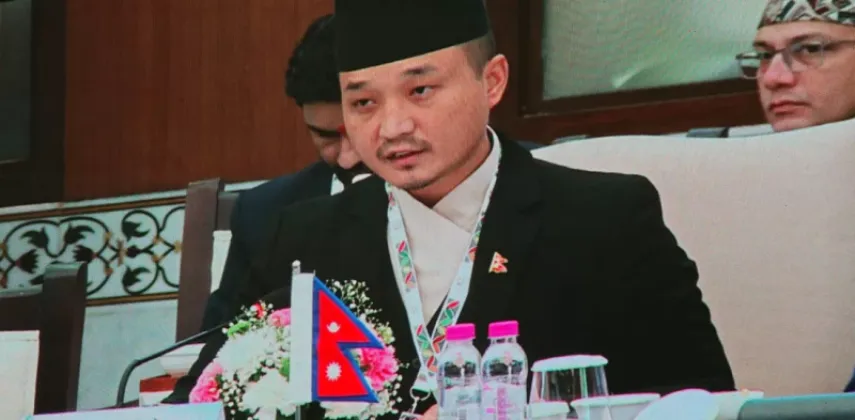
Nepal’s Home Minister Sudhan Gurung called for stronger regional cooperation against transnational crime at the first BIMSTEC Home Ministers’ meeting in India on Tuesday, urging member countries to share information securely and use technology to respond more effectively. Speaking on behalf of Nepal, Gurung said cooperation must be stronger than borders and faster than criminals. Nepali media reported on the meeting on October 13 and 14, 2026.
Call for coordinated regional action
Gurung identified terrorism, human trafficking, drug trafficking, money laundering and cybercrime as threats that require countries in the region to work together. His message was that these challenges cannot be addressed effectively by relying on national borders alone. He urged BIMSTEC members to strengthen cooperation, with information exchange and technology forming key parts of a shared response.
The call for secure information sharing was central to Gurung’s remarks. For regional cooperation to help authorities respond to cross-border offences, countries need ways to exchange relevant information with one another. Gurung stressed that such cooperation should be practical and timely, reflecting his warning that joint efforts must move faster than criminals. He presented stronger coordination not simply as a general principle, but as a means of improving the region’s ability to confront threats that affect more than one country.
The range of crimes cited by the minister also underscored the breadth of the agenda he raised. His list covered terrorism, trafficking in people and drugs, money laundering and cybercrime. Gurung called for a cooperative approach to these different threats, rather than treating them as challenges that can be managed solely through separate national efforts. He emphasized the need for regional partners to work together and make use of technology as part of their efforts to control them.
Proposals for BIMSTEC mechanisms
Gurung also proposed establishing a regional disaster mechanism under BIMSTEC and forming a joint working group. The proposals would give member countries specific regional arrangements to consider alongside his broader call for cooperation. The meeting was the first BIMSTEC gathering of home ministers, providing a forum for Nepal to raise both security concerns and the need for a mechanism addressing disasters.
The proposed joint working group would be a BIMSTEC-level avenue for cooperation, while the suggested disaster mechanism would focus on regional disaster response. Gurung raised these ideas as proposals; the available reports do not indicate that the meeting adopted them or set out a timeline for their establishment. His remarks therefore called on members to consider how regional structures could support cooperation, rather than announcing that new arrangements had already been agreed.
Nepal’s message at the first meeting
Gurung’s address combined a call to counter transnational crime with proposals for sustained cooperation among BIMSTEC countries. Information sharing, technology and joint action were the main elements of his message. The emphasis on speed and secure exchange pointed to the kind of cooperation Nepal wants the region to strengthen, while the suggested working group and disaster mechanism offered possible ways to organize that effort.
The meeting brought home ministers together for the first time under BIMSTEC, and Nepal used the occasion to urge a stronger regional response to shared challenges. Gurung’s central argument was that threats crossing borders require cooperation that can keep pace with them. His proposals now stand as calls for BIMSTEC members to consider closer information exchange, a joint working group and a regional disaster mechanism as part of a more coordinated approach.