
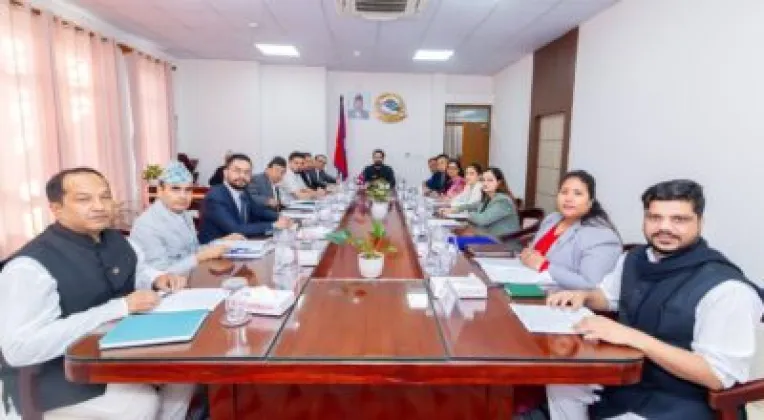
The Council of Ministers of the Government of Nepal, meeting at the Office of the Prime Minister and Council of Ministers (OPMCM) in Singha Durbar, Kathmandu, on November 3, decided to recommend two ordinances to the President for issuance. The recommendation was the most prominent among six major decisions the Cabinet announced following the sitting, according to the government spokesperson, who also serves as the Minister for Education and Sports. The decisions were communicated to the media shortly after the meeting concluded, in keeping with the government's usual practice of briefing reporters through its spokesperson after each Cabinet session.
Two ordinances headed to the President
The headline outcome of the November 3 meeting was the Cabinet's decision to send two ordinances to the President. Under Nepal's constitutional framework, an ordinance is issued by the President on the recommendation of the Council of Ministers, and once issued it carries the same force as an act of the Federal Parliament.
While the spokesperson confirmed the number of ordinances, the announcement did not spell out the subject matter of the two proposed legal instruments in the readout available so far. The full text and the specific areas of law each ordinance touches typically become public only when the instrument is issued and published in the Nepal Gazette, the official government record.
Ordinances are generally resorted to when the Federal Parliament is not in session and the government needs to introduce legislation that cannot wait for the next sitting. Once Parliament reconvenes, an ordinance must be placed before the House, and lawmakers may approve it, amend it through a replacement bill, or allow it to lapse. This mechanism allows the executive to act on urgent matters between parliamentary sessions while keeping ultimate lawmaking authority with the legislature.
Six decisions from a single sitting
Apart from the ordinance recommendations, the government spokesperson said the Cabinet took six major decisions in total on the day. That figure includes the two ordinances put forward to the President, leaving the remaining decisions to be detailed through the government's official communication channels.
The initial readout highlighted the ordinance recommendations as the standout item, and the full breakdown of the other decisions had not been itemised in the information made available at the time of reporting. Cabinet decisions of this kind are usually circulated through the OPMCM and elaborated by the spokesperson in post-meeting interactions with the press, after which the concerned ministries begin implementation.
Cabinet meetings at Singha Durbar, the historic seat of Nepal's government, are typically held on a regular weekly cycle and are usually chaired by the Prime Minister. The November 3 sitting followed that established pattern, with the spokesperson stepping out to brief reporters on the outcome of the deliberations held in Kathmandu.
How the ordinance process works
The constitutional basis
Under Article 114 of the Constitution of Nepal, the President may issue an ordinance on the recommendation of the government when circumstances requiring immediate action exist and Parliament is not in session. An ordinance so issued has the same force and effect as law, but it is not a substitute for parliamentary approval: it must be presented at the next session of the Federal Parliament, and if it is rejected, it ceases to operate.
Successive governments have used this route for legislation they considered urgent, and the practice has periodically drawn comment from lawmakers and legal observers, who stress that ordinances should remain an exception rather than a routine substitute for parliamentary deliberation. That context matters for the two instruments now recommended, since their survival will ultimately depend on how the Federal Parliament treats them once it reconvenes.
For the two ordinances recommended on November 3, the next steps are largely procedural. The President's Office will examine the Cabinet's recommendation, and once the required conditions are met, the ordinances will be issued and published in the Nepal Gazette, through which laws, orders and appointments are notified to the public.
What happens next
With the recommendations formally forwarded, attention now shifts to the Office of the President and, subsequently, to the Federal Parliament. Key points to watch in the coming days include:
- The President's Office is expected to review the Cabinet's recommendation before any ordinance is authenticated and issued.
- Once issued, the full text of each ordinance will appear in the Nepal Gazette, revealing for the first time the specific legal changes involved.
- When Parliament next meets, the ordinances will need to be tabled and approved in order to remain in force.
- The remaining decisions among the six announced are expected to be detailed by the concerned ministries and the spokesperson's office as the briefing process continues.
For now, the government has communicated the headline outcomes of the November 3 meeting: two ordinances recommended to the President and six decisions taken in all. As reported by Khabarhub, further details on the content of the ordinances and the other Cabinet decisions are expected as the government's post-meeting communication continues.


