
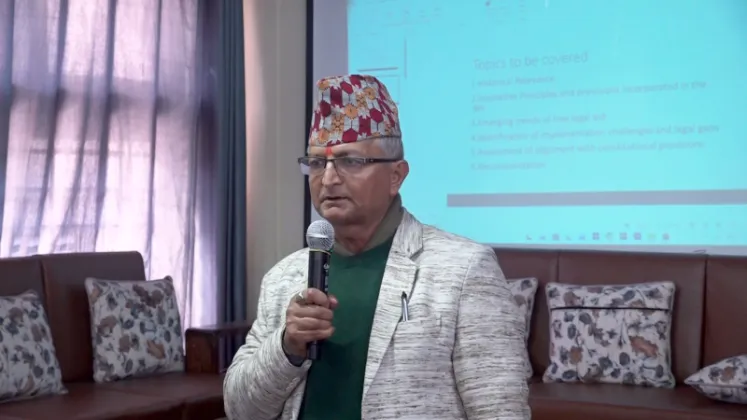
Kathmandu - Nepal Bar Association President Dr. Vijay Mishra has urged that the Free Legal Aid Bill, 2083 be made more effective, practical and sustainable, arguing that the proposed legislation must translate the constitutional promise of free legal aid into real protection for citizens who cannot afford a lawyer. He made the remarks at a stakeholder interaction on the bill organised in Kathmandu under the 'Hello MP' programme, where participants discussed how the draft law could be strengthened before it moves forward. According to reports published by Pradesh Khabar and Nepal Samaya, Mishra offered a range of suggestions during the discussion, which focused squarely on improving the proposed free legal aid legislation.
Mishra's Call: Effective, Practical and Sustainable
Dr. Mishra, who leads the country's largest professional organisation of lawyers, told the gathering that the bill should not remain a symbolic or paper-only exercise. Speaking at the interaction, he stressed three benchmarks that the final law must meet: it must be effective in delivering services on the ground, practical in terms of implementation, and sustainable over the long term rather than dependent on short-lived arrangements.
His central argument, as reflected in the stakeholder discussion, was that legislation dealing with access to justice for the poor must be judged by whether it actually helps the indigent litigant, the detained person without resources, and the family that cannot bear the cost of court proceedings. In that spirit, he placed various suggestions before the participants, calling on those involved in shaping the bill to treat the draft as a document that can still be refined and improved.
The Nepal Bar Association has historically been closely associated with the delivery of legal aid services in Nepal, and the intervention by its president at this stage of the legislative process carries particular weight. Mishra's remarks made clear that the legal profession expects the new law to build on, rather than merely restate, the arrangements that already exist.
Stakeholder Dialogue Under the 'Hello MP' Programme
The interaction in Kathmandu was held under the 'Hello MP' programme, a format that brings members of the federal parliament into direct conversation with stakeholders on issues of public concern and pending legislation. Such platforms are intended to give citizens, professionals and civil society representatives an opportunity to voice their views on draft laws while those laws are still being shaped, rather than after they have been enacted.
The discussion at the Kathmandu event centred on the Free Legal Aid Bill, 2083, with participants examining how the proposed legislation could be strengthened. The exchange among stakeholders focused on the design and operation of the free legal aid system that the bill seeks to create, and on the practical questions that determine whether such a system functions for the people it is meant to serve.
By hosting the conversation under the 'Hello MP' banner, the organisers placed the bill directly before the lawmakers whose support it will need, while also allowing voices from the legal and social sectors to record their expectations. Mishra's suggestions were offered within precisely such an exchange, at a moment when feedback can still inform the drafting.
Why Free Legal Aid Legislation Matters in Nepal
The bill under discussion seeks to give fuller legislative shape to a right that Nepal's Constitution already recognises. Key points of context include:
- The Constitution of Nepal guarantees the right to justice, including the provision of free legal aid to persons who are unable to protect their rights due to income levels, disability or other conditions, with the details to be set out by law.
- A Legal Aid Act, 2054 has governed legal aid schemes in the country for decades, operating through the district-level machinery of the justice system, but stakeholders have long pointed to gaps in its reach and resources.
- The Free Legal Aid Bill, 2083, named after the current Bikram Sambat year, is intended to modernise and expand that framework so that legal representation and legal advice are genuinely accessible to the poor and marginalised.
- The Nepal Bar Association, as the apex professional body of lawyers, has a direct institutional interest in how the law defines eligibility, service delivery and institutional responsibility for legal aid.
It is against this backdrop that Mishra's insistence on an effective, practical and sustainable law should be read. Nepal's legal aid framework, whatever its achievements, has been widely viewed as constrained in coverage, and a new statute is seen by many in the legal community as the opportunity to close those gaps.
The Road Ahead for the Bill
The Kathmandu interaction forms part of the consultative stage that precedes the formal legislative journey of the bill. The feedback and suggestions recorded at such meetings, including those put forward by the Nepal Bar Association president, are expected to feed into the refinement of the draft as it advances toward enactment.
For the government and lawmakers involved, the message from the event was unambiguous: the Free Legal Aid Bill, 2083 will be measured against its ability to function in practice. Mishra's call for the legislation to be effective, practical and sustainable sets the standard by which stakeholders are likely to judge the final text, and his suggestions underline the expectation that the concerns of the legal profession and of poor litigants alike will be reflected in the law.
As the bill progresses, further stakeholder engagement of the kind seen under the 'Hello MP' programme is likely to play a decisive role in determining whether Nepal's new free legal aid legislation fulfils the constitutional commitment on which it is built.


