
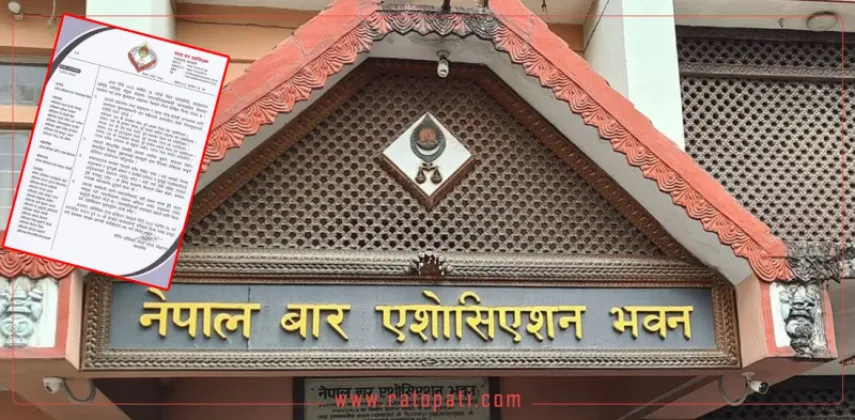
Kathmandu, Nepal - The Nepal Bar Association has formed a six-member committee to gather facts about judges named in the Inam Sapkota WhatsApp message case and to recommend reforms in the country's justice sector. The decision was taken at a joint meeting of the association's central working committee and its advisory committee held on Monday, with the panel given a one-month deadline to complete its work. The committee will be coordinated by former Bar president and senior advocate Chandeshwar Shrestha, according to reports published by RatoPati and Nepal Lead.
The move places the country's largest organization of lawyers at the center of an issue that has raised serious questions about the integrity of the judiciary. By assigning the task to a panel of senior and former office-bearers, the association has signaled that it intends to take a formal, institutional position on the controversy rather than leave it to individual members to comment on.
A senior-led panel with a one-month deadline
The committee announced on Monday brings together lawyers who have previously held some of the most senior positions in the Bar movement, a composition that underlines the weight the association has attached to the assignment. It is coordinated by Chandeshwar Shrestha, who has served as president of the Nepal Bar Association and holds the rank of senior advocate.
The six members of the committee are:
- Chandeshwar Shrestha, former president of the Nepal Bar Association and senior advocate, as coordinator
- Purnaman Shakya, former president of the Supreme Court Bar Association
- Usha Malla Pathak, former vice-president of the Nepal Bar Association
- Surendra Kumar Mahato, former vice-president of the Nepal Bar Association
- Chandra Prasad Kafle, member
- Baburam Aryal, advocate, member
The presence of a former Supreme Court Bar Association president alongside two former vice-presidents of the parent body gives the panel experience drawn from both the apex court's own Bar and the wider legal profession. The inclusion of practicing advocates further extends the committee's reach across different sections of the profession.
The joint meeting of the central working committee and the advisory committee is itself notable. Decisions of this kind, taken by the two bodies meeting together, reflect the views of the association's policymaking leadership as well as its senior counselors, giving the committee's future findings broader institutional backing within the Bar.
Mandate: fact-finding and justice sector reform
The committee's terms of reference, as decided at the meeting, cover two distinct tasks. First, it is to collect facts concerning the judges whose names figure in the Inam Sapkota WhatsApp message case. Second, it is to recommend reforms in the justice sector, a mandate that goes beyond the immediate controversy and looks at systemic improvements.
The one-month deadline set by the joint meeting means the committee is expected to report back within weeks of beginning its work. In that period, it will need to compile information relating to the allegations involving judges and translate its findings into concrete suggestions for reform.
The dual mandate suggests the association is treating the case not merely as a matter of individual accountability, but as an occasion to examine whether the justice sector requires structural changes to prevent similar controversies. What form those recommendations will take remains to be seen, and the committee's report is likely to be closely watched by lawyers, judges and policymakers alike.
The Inam Sapkota WhatsApp message case
The committee's formation follows the Inam Sapkota WhatsApp message case, in which judges were named in WhatsApp messages, a development that has stirred concern within Nepal's legal community and among the wider public. The naming of judges in such messages has prompted questions about the circumstances in which the names appeared and about what the episode reveals regarding pressures on the judiciary.
Judicial independence and the credibility of the courts depend heavily on public confidence that judges decide cases free of outside influence. When the names of judges surface in connection with a controversy of this nature, that confidence can come under strain, making fact-based clarification all the more important. It is precisely this gap that the Bar association's fact-finding committee is designed to address.
For the legal profession, the stakes are particularly high. Lawyers practice before the courts whose conduct is now under question, and the Bar's own standing is tied to the credibility of the judicial system in which it works. An authoritative accounting of the facts, carried out by respected figures from within the profession, is intended to help restore clarity on an issue that has otherwise been the subject of discussion without a settled institutional response.
What the report could mean for the justice sector
If the committee completes its work within the one-month timeframe, the Nepal Bar Association will have in hand both a factual account of the judges' connection to the Inam Sapkota WhatsApp message case and a set of reform recommendations for the justice sector. Those outputs could shape the association's future positions on judicial accountability and inform debate over reforms within the courts and the wider legal system.
The choice of Chandeshwar Shrestha, a former Bar president, to lead the panel, supported by figures such as Purnaman Shakya, Usha Malla Pathak, Surendra Kumar Mahato, Chandra Prasad Kafle and Baburam Aryal, indicates that the association expects its findings to carry authority both within the profession and before the public. As the deadline approaches, attention will turn to what facts the committee gathers and how its reform proposals are received by the judiciary, the legal community and the government.


