
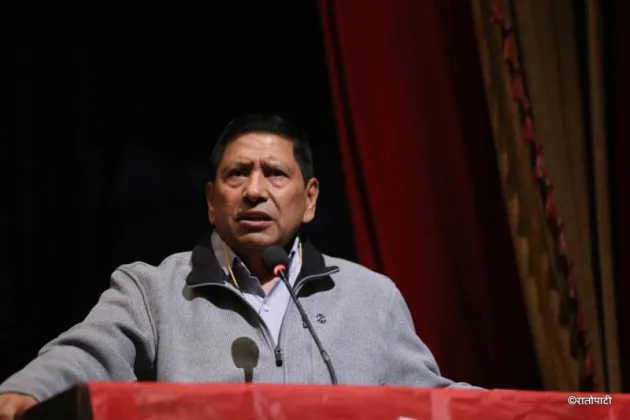
Nepali Communist Party leader and former Deputy Prime Minister Narayan Kaji Shrestha said in Kathmandu that the Inam Sapkota case is not an ordinary incident, but a symbolic reflection of Nepal’s state and society. He described it as evidence of what he called broker capitalism and the state’s status-quoist character, linking the case to Nepal’s history of political change and democratisation.
A case with wider political meaning
Shrestha’s remarks frame the Inam Sapkota case as more than an isolated episode. In his interpretation, it represents broader features of how the state and society function. By calling it a mirror of the country’s state and social character, he placed the case within a wider political argument about the forces shaping public life in Nepal.
The former deputy prime minister used the term “broker capitalism” to describe the system he believes the case reflects. His comments presented that system as connected to the state’s tendency to preserve the status quo. Rather than treating the case as separate from the country’s political structure, he argued that it should be understood in relation to those wider conditions.
That distinction is central to Shrestha’s assessment. Describing an incident as ordinary would limit attention to the incident itself; describing it as symbolic draws attention to what it may represent about the institutions and social character around it. Shrestha’s remarks therefore put the case into a larger discussion about the relationship between political power, economic interests and the state, while presenting that interpretation as his own assessment.
Link to political change and democratisation
Shrestha also connected the case to Nepal’s history of political change and democratisation. His comments placed the issue against the backdrop of the country’s experience of political transformation, suggesting that the meaning of the case should be considered alongside that history. The connection made his argument broader than a comment on a single case: it raised questions about whether the state and society have changed in the ways expected through political transformation.
By invoking democratisation, Shrestha tied his criticism to the promise of political change. His remarks suggested that the case offers a way to examine the gap between transformation as a historical process and the persistence of conditions he described as status quoist. He did not present the case as detached from that trajectory, but as something that, in his view, reflects continuing characteristics of the state and society.
Shrestha’s assessment
The statements reported about Shrestha’s remarks focus on the political significance he assigns to the case. They do not, in themselves, set out the details of the case or establish its facts. His central point is instead that the case should be read symbolically: as a reflection of broker capitalism, the state’s status-quoist nature and the broader social and political character of Nepal.
That framing gives the case a place in a wider debate over the meaning of political change. Shrestha’s argument is that the country’s history of transformation and democratisation provides important context for considering present-day events. In that sense, his description of the case as a mirror is also a call to look beyond the immediate episode and consider what it reveals, in his view, about the state and society.


