
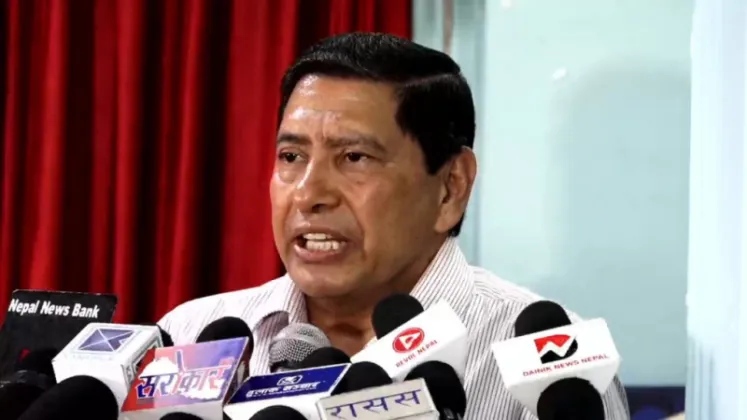
Kathmandu - Narayan Kaji Shrestha, a leader of the Nepal Communist Party (NCP), has accused the government of attacking Nepal's democratic system and the fundamental rights guaranteed by the constitution, saying the people have once again been forced to endure authoritarian rule, this time imposed by a government that came to power through elections. In remarks reported on Saturday by Nepal Press and Nagarik News, Shrestha also strongly condemned a recent crackdown on journalists, including arrests, and demanded that such actions be stopped immediately.
The statement places press freedom and civil liberties at the centre of a sharpening confrontation between the ruling side and the opposition, and it frames the treatment of journalists not as a routine law-and-order matter but as part of what Shrestha calls a wider assault on constitutional democracy.
‘Cruel tyranny’ from an elected government
Shrestha's central charge was pointed and direct. Under a democratic system, he said, the people have again been made to suffer authoritarianism, and it is an elected government that has imposed it. As Nepal Press reported, he described the situation as a “cruel tyranny” carried out by a government that owes its very position to the ballot box.
The accusation cuts to the heart of the government's democratic credentials. In Shrestha's framing, the problem is not the misconduct of a single agency or official but a pattern of conduct by the state itself: a government that should be the guardian of democratic norms has instead become the source of their erosion, he said, attacking both the democratic system and the constitutionally guaranteed fundamental rights of citizens.
The reference to fundamental rights carries particular weight in Nepal. The constitution promulgated in 2015 enshrines freedom of expression, freedom of the press and other civil liberties as fundamental rights, placing them beyond the reach of ordinary political convenience. To accuse a government of violating those provisions is, in effect, to accuse it of governing against the country's own supreme law.
The word “tyranny” also carries historical resonance in Nepal, a country that has experienced royal takeovers and partyless rule within living memory. By insisting that authoritarianism has returned under a democratic, elected government, Shrestha sought to make clear that the threat he sees comes not from a palace or an army, but from the very institutions the people themselves chose.
Arrests of journalists condemned as ‘vile tyranny’
According to Nagarik News, Shrestha reserved his sharpest language for the recent arrest of journalists, which he called “vile tyranny”. He demanded that the crackdown be stopped immediately, saying that actions against members of the press amount to an attack on rights that belong to all citizens.
The demand for an immediate halt was the most concrete element of his statement. Neither report detailed the individual cases behind his remarks, but both make clear that the arrests of journalists were the immediate trigger for his intervention, and that he regards the detention of reporters for their work as indefensible in a democracy.
The stakes, in his telling, extend well beyond the press corps. When journalists can be arrested for their work, the information citizens need to judge their own government is placed at risk, and the accountability that elections are supposed to provide loses meaning. His statement thus binds the fate of the press to the fate of democracy itself.
Key points from Shrestha's statement
- The government is attacking the democratic system and the constitutionally guaranteed fundamental rights of the people.
- Under democracy, citizens have again been forced to endure authoritarianism imposed by an elected government.
- He described the government's conduct as “cruel tyranny” and the arrest of journalists as “vile tyranny”.
- He demanded that the crackdown on journalists be stopped immediately.
Pressure now shifts to the government
By tying the treatment of the press to the broader health of democracy, Shrestha has sought to move the dispute beyond individual arrests and turn it into a question of constitutional conduct. His demand is unambiguous: an immediate end to actions against journalists. Neither report indicated that the government had responded to his remarks.
For now, his statement stands as one of the most direct charges an opposition leader has levelled at the government: that tyranny has returned to Nepal not through the collapse of democracy, but through a government elected under it, and that the arrest of journalists is where that tyranny is most visible. The demand that such actions stop immediately now awaits an answer.


