
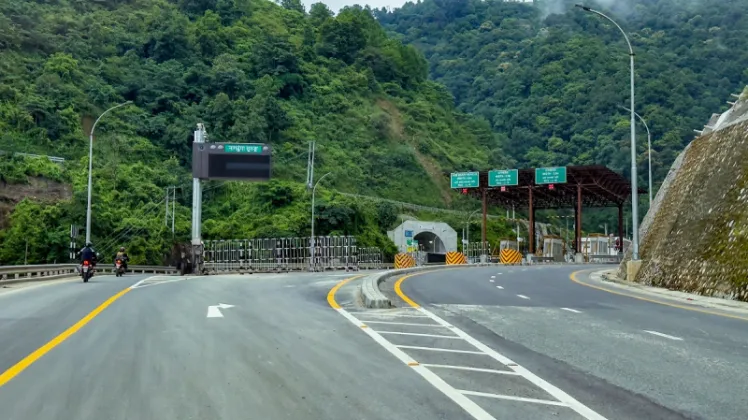
Toll collection on the Nagdhunga tunnel road officially began today, turning the capital's main western gateway into a paid facility for every vehicle that uses it. Under the new arrangement, the Nagdhunga-Sisnekhola tunnel route has made toll payment mandatory for all passing vehicles, meaning drivers can no longer cross this stretch of the highway without paying the prescribed fee. The change directly affects traffic on Kathmandu valley's main western entry route, one of the busiest and most strategically important corridors connecting the capital with the rest of the country.
The introduction of tolling marks a significant shift for commuters, freight operators and long-distance travelers who depend on this route daily, as reported by Nepal Samaya. What was previously a free crossing for all traffic is now a toll facility, and authorities have moved to enforce payment from the very start of collection.
The Valley's Western Gateway Enters the Toll Era
Nagdhunga sits on the western rim of Kathmandu valley and has long served as the principal entry and exit point for traffic moving between the capital and destinations to the west and southwest. The tunnel route, running between Nagdhunga and Sisnekhola, carries this flow of vehicles through a modern engineered crossing on a stretch of highway that has historically been one of the most heavily used approaches to the valley.
With toll collection now in force, every vehicle passing through the tunnel is required to pay. The obligation applies to all categories of traffic using the route, leaving no provision under which a passing vehicle can use the tunnel without settling the fee. This makes the Nagdhunga-Sisnekhola stretch one of the key paid road facilities serving the valley, alongside the highways that feed into it from the western side.
Key points from today's development:
- Toll collection on the Nagdhunga tunnel road began today.
- Payment is now mandatory for all vehicles using the Nagdhunga-Sisnekhola tunnel route.
- The route forms part of Kathmandu valley's main western entry corridor.
- The change affects commuter, commercial and long-distance traffic alike.
What Drivers and Transport Operators Need to Know
For the thousands of travelers who move between Kathmandu and the western districts, the practical effect is straightforward: using the tunnel now involves a payment step that did not exist before. Drivers planning to cross the pass should be prepared to pay the toll as part of their journey, and transport companies that run buses, trucks and other commercial vehicles along the corridor will need to account for the fee in their regular operations.
As reported by Nepal Views, fees were set to be charged for using the tunnel from today, with the mandatory payment structure applying to the full range of vehicles passing through. The initial reports did not lay out a detailed breakdown of rates by vehicle type, so travelers are advised to watch for official notification from the concerned authorities regarding the exact fee schedule and payment methods.
For daily commuters, the toll adds a recurring cost to trips that cross the western pass. For commercial operators, whose vehicles use the route constantly to move goods and passengers in and out of the valley, the mandatory fee becomes a new line item in operating expenses. Over time, how these costs are absorbed, whether by operators, by shippers or by passengers, will become clearer as the system settles into routine use.
Why the Nagdhunga Route Matters So Much
The significance of today's change lies in the route itself. The western entry corridor is the artery through which much of the traffic between Kathmandu and the rest of the country flows, linking the capital with the highway network that extends toward the Terai plains and the hill districts beyond. Goods trucked into the capital, buses departing for cities in the west and travelers returning home all funnel through this single approach, which is why any operational change on the route resonates far beyond the tunnel itself.
The Nagdhunga-Sisnekhola tunnel was developed precisely to improve travel along this corridor, offering a engineered crossing in place of the challenging pass section that has long constrained traffic between the valley and the highway network on the western side. Converting the tunnel into a toll facility from today reflects the standard model for operating such modern road infrastructure, under which toll income supports the running and upkeep of the facility. The enforcement of mandatory payment from the outset signals that authorities intend the toll regime to be taken seriously from day one.
What Travelers Should Watch Next
In the days ahead, attention will turn to how smoothly the tolling system functions in practice, how queues and payments are handled at the collection point, and whether the authorities publish a clear, detailed fee schedule for different vehicle categories. Travelers using the western corridor are encouraged to factor the toll into their journey planning and to stay updated through official channels and follow-up reporting.
For now, the message to every driver heading toward the Nagdhunga-Sisnekhola tunnel is unambiguous: the era of free passage on the valley's main western entry route has ended, and from today, using the tunnel means paying the toll.


