Sanima Bank has begun issuing the N-Tag, the RFID-based device required to travel through the Nagdhunga-Sisnekhola tunnel, from all of its branches across the country, in a move that should make journeys through Nepal's first modern road tunnel noticeably easier for motorists. With the tag now available through the bank's nationwide network, drivers no longer need to queue to pay tolls when they use the tunnel, which runs on an electronic toll collection system managed by the Road Board Nepal. According to a report by Ratopati, the bank has rolled out the facility across all of its branches, putting the device within reach of drivers wherever they bank.
Nepal's first modern road tunnel
The Nagdhunga-Sisnekhola tunnel occupies a special place in Nepal's road infrastructure: it is the country's first modern road tunnel. The description is not merely symbolic. A modern road tunnel of this kind brings together civil engineering and electronic systems, pairing the physical passage for vehicles with a tolling backbone that identifies vehicles and settles payments without the driver having to handle cash at a counter. The Road Board Nepal manages the electronic toll collection system on which the tunnel's day-to-day operation depends.
For drivers, the practical consequence is that the N-Tag is not an optional extra but a requirement. The tunnel's electronic toll collection system is built around the device, and vehicles are expected to carry one to travel through. That makes the question of where and how easily a motorist can obtain the tag an important one, and it is precisely the question that Sanima Bank's rollout is designed to answer.
How the RFID-based N-Tag works
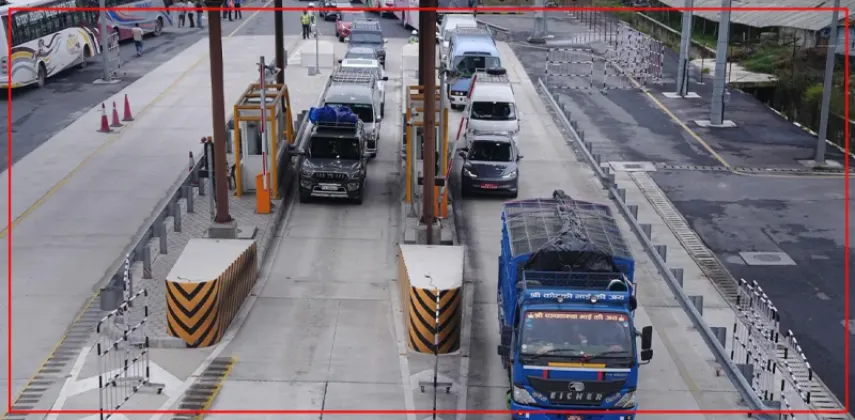
The N-Tag is built on radio frequency identification (RFID) technology. In systems of this kind, a small tag associated with the vehicle carries an identity that the tolling infrastructure can recognise. When a tagged vehicle arrives at the toll point, the device is read and the toll is processed electronically, allowing the vehicle to pass without the driver stopping to queue and pay by hand.
Because the tag does the work, the transaction is quick and repeatable, which is what gives an electronic toll collection system its advantage over manual payment. Every journey through the tunnel depends on the tag being present and readable, so the availability of the device is central to how smoothly the tunnel functions for the travelling public.
A familiar bank counter instead of a toll queue
The rollout through Sanima Bank changes where motorists go to get the tag. Rather than treating the device as something to be arranged in the course of a journey, drivers can now obtain it at any of the bank's branches across the country, whether during a routine visit to their own branch or while running other errands. For a device that is mandatory for using the tunnel, that kind of wide availability matters.
The bank's nationwide footprint also means the tag is accessible to motorists well beyond the capital. A driver who lives far from the Nagdhunga route can pick up an N-Tag in advance, so that the first time the vehicle approaches the tunnel it is already equipped. In effect, obtaining the tag becomes part of ordinary banking rather than a separate task tied to a specific trip.
What motorists need to know
- Where to get it: the N-Tag is available from all Sanima Bank branches across the country.
- What it is: an RFID-based device required for travel through the Nagdhunga-Sisnekhola tunnel.
- How tolls are paid: through the tunnel's electronic toll collection system, managed by the Road Board Nepal, removing the need to queue to pay tolls.
- Why it matters: the tunnel is Nepal's first modern road tunnel, and the tag is the device on which its tolling system relies.
Less time in the queue, more time on the road
The clearest benefit for drivers is time. Because tolls are collected electronically through the N-Tag, motorists are spared the need to queue to pay tolls, an advantage that grows more valuable the busier the route becomes. The electronic arrangement also does away with the small frictions of manual payment, from stopping at a counter to settling the amount by hand, since the toll is handled through the tag itself.
For the Road Board Nepal, which manages the tunnel's electronic toll collection system, the wider distribution of tags through a commercial bank ties the tunnel's tolling to the country's broader financial network. Sanima Bank's branch network becomes the distribution channel for the very device on which the system's collections depend, an arrangement that embeds the tunnel's operation into everyday banking services.
As reported by Ratopati, Sanima Bank's decision to issue the N-Tag from all of its branches makes the country's first modern road tunnel easier to approach for drivers across Nepal. For anyone planning to use the Nagdhunga-Sisnekhola tunnel, the message is simple: the tag can now be picked up at a local Sanima Bank branch, alongside everyday banking, before the journey begins.