
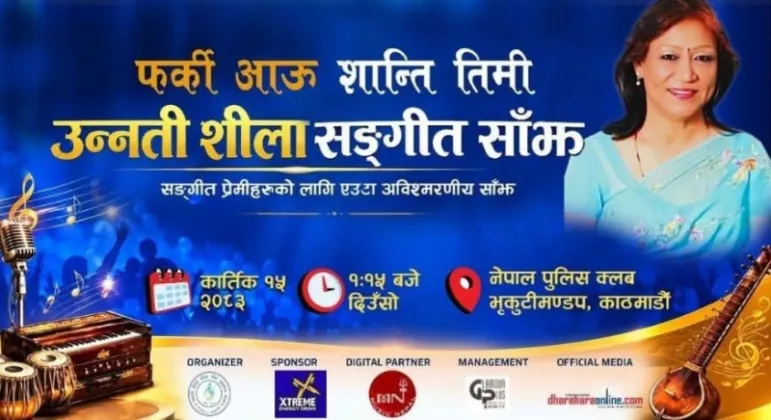
A special musical programme honouring veteran litterateur, lyricist and academician Unnati Bohara ‘Shila’ was held on Sunday at the Nepal Police Club in Bhrikutimandap, Kathmandu. Titled “Pharki Aau Shanti Timi, Unnati Shila Sangeet Samarpan Saanjh,” the gathering recognised her more than five decades of contributions to Nepali literature, song and music, as well as social service. It was organised by the Unnati Bohara Shila Geet Puraskar Manch, which had announced the programme at a press conference in Kathmandu.
A tribute to a long creative career
The evening placed Bohara’s work at the centre of a programme framed as a musical dedication. Its title combined a call to return with a tribute to Shila through music, signalling the event’s focus on honouring her contributions. The organisers’ stated purpose was to recognise a career spanning more than five decades across literature, songwriting and music, alongside her work in social service.
Bohara is identified by the organisers and reports as a veteran litterateur, lyricist and academician. The breadth of those roles gives the tribute a scope beyond songwriting alone: it acknowledges her place in Nepali literary and musical life as well as her academic work and service to society. The programme brought those strands together under a single public honour, with music serving as the form through which the dedication was presented.
The event’s title also included Bohara’s name and the phrase “Sangeet Samarpan Saanjh,” describing the occasion as an evening devoted to music. The programme’s focus, as reported, was recognition of her longstanding contributions rather than a single achievement. The announcement of the special programme and subsequent coverage detailed the tribute’s purpose and venue.
Organised by the Unnati Bohara Shila Geet Puraskar Manch
The Unnati Bohara Shila Geet Puraskar Manch organised the musical evening and announced it at a press conference in Kathmandu. The announcement provided advance notice of a programme dedicated to Bohara’s work, while the event itself took place at the Nepal Police Club in Bhrikutimandap. The venue made the tribute a public gathering in the capital, centred on the honouree’s contributions to Nepali culture and society.
The Manch’s name links it directly to Bohara and to song, reflecting the musical emphasis of the evening’s title. The available reports describe the programme as an honour and a musical dedication. They do not identify a separate award presentation as part of the event, so the occasion is best understood from the stated details as a tribute recognising her body of work and service.
The Khabarhub report also covered the programme and its recognition of Bohara’s long record of contribution. Together, the reports describe an event organised specifically to acknowledge a figure whose work has crossed literary, musical, academic and social fields.
Recognising contributions across several fields
The tribute brought attention to the breadth and duration of Bohara’s public contributions. More than five decades of work in Nepali literature, song and music represents a sustained engagement with creative practice, while her academician status and social service add further dimensions to the recognition. The organisers’ decision to dedicate a musical evening to her connected the programme’s form with one of the fields for which she was being honoured.
The event’s significance, as described by its organisers, lay in recognising Bohara’s extended contribution rather than focusing on one specific work or moment. By bringing her name into the programme title and placing the musical dedication in a Kathmandu venue, the Manch created a public occasion around her career. The stated focus remained on honouring her work across multiple areas and acknowledging the service she has given over many years.
The Sunday gathering thus served as a formal musical tribute to Unnati Bohara ‘Shila’, organised by the Unnati Bohara Shila Geet Puraskar Manch at the Nepal Police Club in Bhrikutimandap. Its central message was recognition of a veteran figure whose more than five decades of contribution have included Nepali literature, song and music, academic work and social service.


