
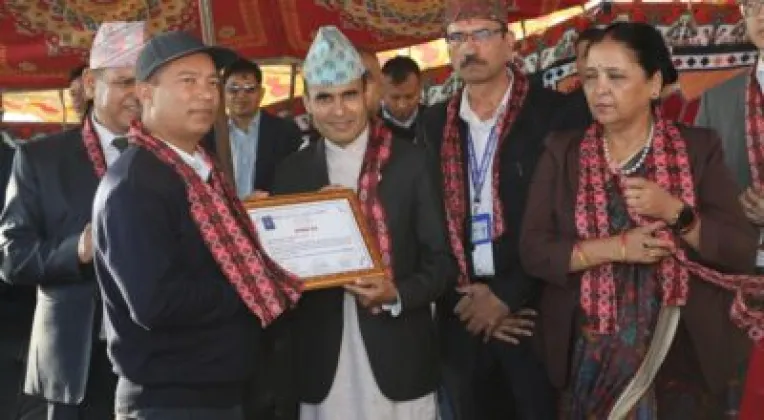
KATHMANDU - Information and Communication Minister Dr. Vikram Timilsina on Monday urged Nepal Telecom to remain prepared for disasters at all times, saying that timely information during a crisis can save lives. He was speaking at a function organised in Kathmandu to honour employees of the company who helped quickly restore telecommunications services disrupted by the Bhotekoshi flood on Bhadra 10. The minister stressed that the true test of a communication network comes in moments of disaster, when a warning received even slightly earlier can determine whether people reach safety. Those who receive warnings even five seconds earlier, he noted, can survive, underlining why telecom operators must treat readiness as a permanent duty rather than an occasional response.
Timely Information Saves Lives
Timilsina placed the life-saving value of information at the centre of his address. Timely information during disasters saves lives, he said, because it gives people the moments they need to move to safety before sudden hazards strike. His observation that a person who receives a warning even five seconds earlier can survive served as a pointed reminder of how little time is often available when disaster strikes, and of how much depends on the systems that deliver warnings to those in danger.
The minister's remarks carried a clear message for Nepal Telecom: preparedness must be continuous. Being prepared, in his framing, means ensuring that warnings and communication do not fail at the precise moment they are needed most. The setting reinforced the point. The company was being honoured precisely because its employees had moved quickly to restore services after the Bhotekoshi flood, and the minister used the occasion to turn that recognition into a forward-looking expectation for the institution as a whole.
Honouring a Rapid Response to the Bhotekoshi Flood
The event in Kathmandu focused on the employees who helped quickly restore telecommunications services that the Bhotekoshi flood had disrupted on Bhadra 10. Their work was recognised as an example of the speed and commitment that disaster response demands from the country's telecommunications sector.
The recognition carried significance well beyond ceremony. When floods or landslides sever communication links, the effects spread immediately: families cannot reach relatives, rescue teams struggle to identify where help is most needed, and the flow of information that guides relief decisions slows or stops. Restoring services quickly therefore does more than reconnect phones and data connections. It reopens the channel through which warnings travel, coordination happens and reassurance reaches affected communities. By honouring the staff involved, the event drew attention to the technicians and field personnel whose effort stands behind the resilience of the network.
The timing of the disruption also reflects a familiar seasonal reality. Nepal's monsoon months regularly bring floods and landslides that damage roads, bridges, power lines and communication infrastructure, often in remote and difficult terrain. Each such event cuts communities off at the very moment they most need to call for help. The Bhotekoshi flood that disrupted telecom services on Bhadra 10 was, in that sense, another reminder of how exposed the country's infrastructure remains during the rainy season, and how vital rapid restoration work is to reducing the human cost of such disasters.
Preparedness as a Standing Responsibility
In honouring past performance, Timilsina pointed firmly toward the future. His central message to Nepal Telecom was that it must remain prepared during disasters, not simply respond after damage has already occurred. As reported by Khabarhub and Gorkhapatra Online, his remarks combined appreciation for the restoration effort with a clear expectation of continued readiness from the company.
Key points from the minister's address included:
- Disaster readiness must be permanent. Nepal Telecom should keep itself prepared at all times so that communication services can withstand and recover quickly from disaster-related disruption.
- Information saves lives. Timely warnings allow people to act before danger reaches them, making the speed of communication a matter of survival.
- Every second counts. People who receive warnings even five seconds earlier can survive, a measure of how small margins decide outcomes in sudden disasters.
Taken together, the minister's remarks framed the telecommunications sector as an essential link in the chain of disaster response, from early warning to rescue and relief. The function thus ended on a dual note: gratitude for the employees who helped restore services swiftly after the Bhotekoshi flood, and a reminder that the same vigilance will be expected the next time disaster tests the network. As Timilsina emphasised, in a disaster the difference between loss and survival can be measured in seconds, and the responsibility for buying those seconds rests with those who keep the country connected.


