
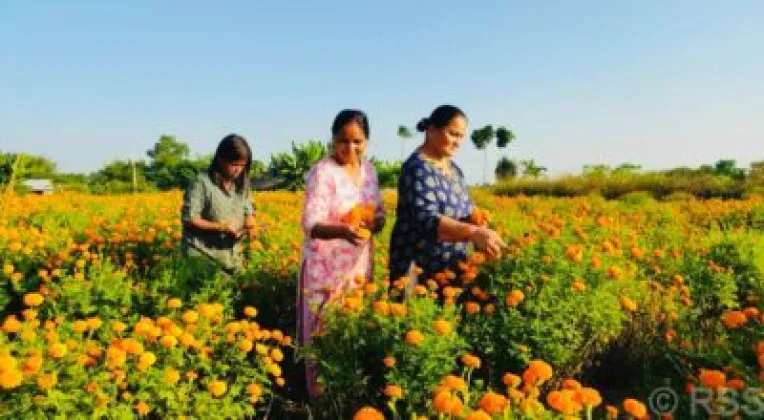
As the Tihar festival draws near, marigold fields across Nepal are turning into busy workplaces. In Gundu of Bhaktapur, farmers are harvesting bright velvet flowers and stringing them into garlands, while women's groups in Jhapa and Tanahu are working to meet festival demand through collective flower farming. Among them, 45 women in Aandhimul, Aabukhaireni Rural Municipality-1 of Tanahu district, have expanded cultivation to 45 ropanis and are aiming to sell marigolds worth Rs 1 million this Tihar, after recording sales of Rs 900,000 last year.
Gundu's marigold fields hum with festival-season work
In Gundu, Bhaktapur, the run-up to Tihar has brought its annual burst of activity to the flower fields. Farmers are out in their plots picking marigolds, and the freshly harvested blooms are quickly carried home, where garlands are strung one flower at a time. A photo feature published by Rato Pati captures the hustle and bustle of picking velvet flowers and tying garlands in the area, offering a glimpse of the labour that fills local markets with colour when the festival begins.
Timing is everything for the growers. Marigolds, known locally as sayapatri, must be harvested so that they reach the market fresh and in full bloom, and the days immediately before the festival are the busiest of the entire season. Once strung, the garlands move from the villages to vendors, who sell them on to households preparing for the celebrations.
For farming families in Gundu, the Tihar period represents the payoff for months of work. The flowers picked and garlands tied in these days will decorate doorways, shops and places of worship across the region once the festival of lights gets under way.
Women in Jhapa turn flowers into festival income
In Takram, Ward No. 10 of Shivasatakshi Municipality in Jhapa district, women have been earning income through collective flower farming as Tihar approaches. Rather than working isolated plots on their own, the women grow flowers together, pooling their labour and focusing on the crop that sees the sharpest demand during the festive season.
The collective approach has given rural women in the area a route into commercial agriculture, turning the weeks around Tihar into a concentrated earning period. Khabarhub reported on the group's activity as part of its coverage of festival-season flower farming, which shows similar initiatives emerging in districts across the country.
Tanahu's women farmers target Rs 1 million in Tihar sales
The most striking numbers this season come from Aandhimul, Aabukhaireni Rural Municipality-1 of Tanahu district. A group of 45 women engaged in collective commercial flower farming has expanded cultivation to 45 ropanis, roughly 2.3 hectares, and is aiming for sales of Rs 1 million during this Tihar, according to Khabarhub.
The group's festival-season profile underscores the scale of the operation:
- 45 women are engaged in collective commercial flower farming in Aandhimul.
- Cultivation now covers 45 ropanis, or about 2.3 hectares of land.
- The group sold flowers worth Rs 900,000 during last year's Tihar season.
- This year, members are targeting Rs 1 million in marigold sales.
The target for this year exceeds the group's actual sales from last season, a sign of the steady growth the collective has achieved from one festival to the next. For the members, the seasonal trade converts months of cultivation into a significant cash income at a single point in the year, with demand peaking precisely when their crop is ready for harvest.
A festival staple powering a seasonal rural economy
Marigold garlands are among the most recognisable sights of Tihar, the five-day festival of lights. Households use them to decorate homes and shops and to offer in worship during the festival's prayers, and that demand makes the weeks around Tihar the most important sales window of the year for flower growers of every scale.
The reports from this season illustrate how widely that demand is felt. In the hills of Bhaktapur, family farmers in Gundu are harvesting and stringing garlands for the market. In the Tarai plains of Jhapa, women farming collectively in Shivasatakshi Municipality are earning festival-season income from their flowers. And in the hill district of Tanahu, an organised women's group has turned marigold farming into a commercial venture with a million-rupee target.
With the harvest under way in Gundu, collective farms active in Jhapa and record ambitions in Tanahu, this year's Tihar once again promises to transform Nepal's marigold fields into a meaningful source of seasonal income, particularly for rural women who grow the flowers and tie the garlands that brighten homes across the country during the festival.


