
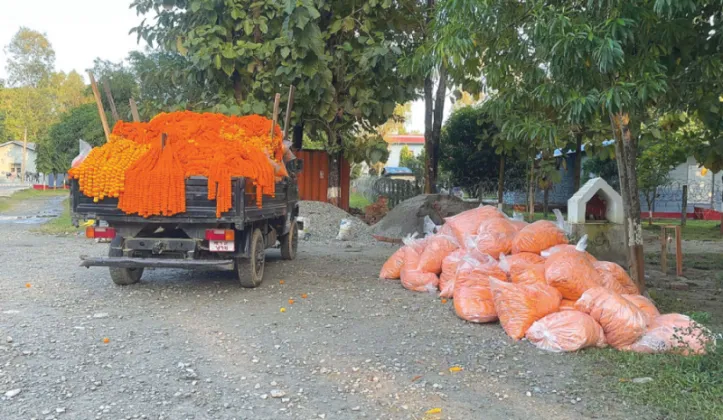
Armed Police Force (APF) personnel in Morang district have seized marigold flowers and garlands worth approximately Rs 2.5 million that had been illegally brought into Nepal from India. The consignment was intercepted while it was being taken for storage in a cold store ahead of Tihar, the festival of lights, when demand for marigolds across the country reaches its annual peak. The seizure was carried out by a team deployed from the Armed Police Force Nepal No. 3 Gan Headquarters, Kankalini, in Morang, according to reports published by Gorkhapatra Online and Pradeskhabar.
A Consignment Bound for the Cold Store
The flowers and garlands were intercepted as they were being moved into cold storage, a step that allows traders to preserve perishable blooms for several days until they can be sold at the most profitable point of the festival season. With Tihar approaching, the timing of the interception meant the consignment was stopped before it could reach retailers and buyers preparing for the celebrations.
The estimated value of around Rs 2.5 million points to the commercial scale of the shipment. Marigold garlands are among the most heavily traded festival commodities in Nepal, and prices in local markets typically climb sharply in the final days before Laxmi Puja and Bhai Tika as demand outpaces supply. A consignment of this size would have represented a significant stock for the festival market.
Key Facts at a Glance
- Seized goods: Marigold flowers and garlands
- Estimated value: About Rs 2.5 million
- Origin: Illegally brought into Nepal from India
- Circumstances: Intercepted while being taken for storage in a cold store
- Timing: Ahead of the Tihar festival
- Unit involved: Armed Police Force Nepal No. 3 Gan Headquarters, Kankalini, Morang
Marigolds and the Tihar Economy
Marigolds, known in Nepali as sayapatri, hold a central place in Tihar celebrations. Over the five days of the festival, strings of the bright orange and yellow flowers are used to decorate homes, shops and streets, to worship the goddess Laxmi on Laxmi Puja, and to honor cows on Gai Tihar and dogs on Kukur Tihar. Sisters also place marigold garlands around their brothers during Bhai Tika, the final day of the festival. This ritual and decorative demand makes the flower one of the most sought-after items of the season, and for many seasonal growers and traders the festival represents the single most important sales window of the year.
Demand for marigolds typically rises so sharply in the days before the festival that domestic production alone does not always cover it, and supplies from India supplement the market through both formal and informal channels. Because flowers are highly perishable, cold storage becomes critical for anyone holding large volumes, since refrigeration keeps garlands fresh until the peak selling days. It is that seasonal economics that gives consignments like the one seized in Morang their value, and that also creates an incentive for some traders to avoid the cost and paperwork of legal importation.
Border Vigilance in the Festival Season
The Armed Police Force is one of Nepal's principal security agencies and is deployed along the southern border to check smuggling and other cross-border crimes. Units stationed in Tarai districts such as Morang carry out regular patrols and searches, and enforcement activity generally intensifies during festival periods, when trade volumes and the movement of goods across the border both increase.
Goods brought in illegally bypass customs duties and taxes, costing the state revenue and undercutting farmers and licensed importers who follow the rules. In the flower trade, the impact falls on local growers who depend on the short Tihar season for a large share of their annual income, as well as on traders who import marigolds through official channels and pay the applicable duties. Seizures of untaxed festival goods are therefore closely watched by both the trading community and farmers.
For Morang, a district with active trade links across the border, the operation highlights the enforcement focus on festival-season commerce. The APF team from No. 3 Gan Headquarters, Kankalini, intercepted the flowers before they could be stored and distributed, keeping a consignment valued at roughly Rs 2.5 million out of the market.
With Tihar approaching and garland sales set to climb in the coming days, the seizure underscores both the scale of Nepal's festival flower trade and the continuing attention security agencies are paying to goods crossing the border illegally during the festive period.


