
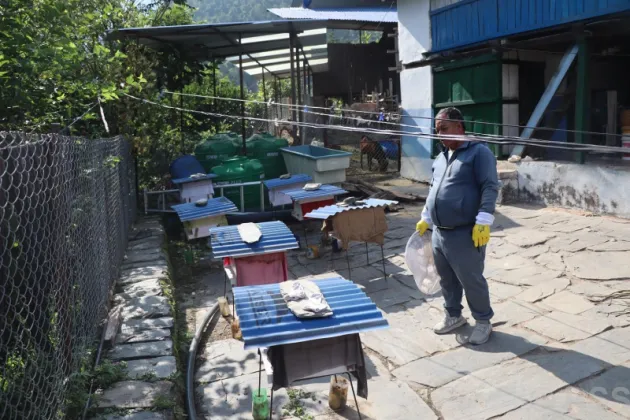
Mangala Rural Municipality in Myagdi district has approved a project to promote income generation and employment through commercial beekeeping, with implementation planned for this year. The project carries a total budget of NPR 10 million and has been approved under the Chief Minister Innovation Partnership Programme of the Gandaki Province government, according to Chief Administrative Officer Amrit Dahal.
With the endorsement, beekeeping moves to the centre of the rural municipality's economic agenda for the year, backed by a cost-sharing arrangement under which the provincial government funds 70 percent of the project and the local level contributes the remaining 30 percent. The approval was reported by RatoPati and Khabarhub.
Joint Funding Model Behind the NPR 10 Million Project
Under the approved formula, the Gandaki Province government will provide NPR 7 million of the NPR 10 million budget, while Mangala Rural Municipality will mobilise NPR 3 million from its own resources. Dahal confirmed the 70:30 division between the province and the rural municipality at the time of the project's approval.
The cost-sharing structure gives the local government a direct financial stake in the project while ensuring that the bulk of the investment comes from provincial coffers. Arrangements of this kind are generally designed to align the interests of both tiers of government, with the local level responsible for carrying the project forward on the ground and the province providing the larger share of the capital.
Key details of the approved project include:
- Project focus: Income generation and employment promotion through commercial beekeeping
- Total budget: NPR 10 million
- Provincial contribution: 70 percent of the cost, amounting to NPR 7 million
- Local contribution: 30 percent of the cost, amounting to NPR 3 million
- Funding programme: Chief Minister Innovation Partnership Programme, Gandaki Province
- Implementation site: Mangala Rural Municipality, Myagdi district
The confirmation of the funding split by the rural municipality's top administrative officer provides a clear financial framework for the initiative as it moves from approval to execution within the year.
Approval Through the Chief Minister Innovation Partnership Programme
The Chief Minister Innovation Partnership Programme serves as the provincial government's channel for backing innovative projects undertaken together with local governments. Mangala Rural Municipality's beekeeping proposal secured approval under this programme, bringing a substantial provincial allocation into the local economy for a project concentrated on a single productive sector.
As its name suggests, the programme links provincial resources with local implementation capacity, and the beekeeping project illustrates how that partnership model is being applied in Myagdi district. For a rural municipality, securing provincial co-funding of NPR 7 million represents a significant injection of resources relative to what the local level would have been able to allocate on its own.
The approval also highlights the role of the rural municipality's administration in identifying and packaging proposals for provincial support. With the project now endorsed and the budget confirmed, the local government can proceed with the administrative groundwork needed to begin implementation.
Income Generation and Employment at the Core
The project's stated purpose, as reflected in its title, is to raise incomes and create employment for local residents through commercial beekeeping. Unlike beekeeping practiced at the household level mainly for home consumption, commercial beekeeping involves maintaining bee colonies at a scale oriented toward producing honey and other bee products for the market.
Beekeeping has long been practiced across Nepal's hill and mountain districts, where floral diversity supports honey production. Because it requires limited land and can be combined with existing farm work, it is widely promoted as a livelihood option for rural households, a consideration that fits with the income and employment outcomes named in the Mangala project.
Bees also contribute to the pollination of crops and plants in the surrounding area, an added benefit for a farming community beyond the honey itself. In this sense, the project's dual objectives of income generation and employment promotion sit within a broader set of advantages that beekeeping can offer to a rural economy.
By seeking provincial backing under the innovation partnership framework rather than funding the initiative entirely from its own budget, the rural municipality has positioned the project as a shared provincial and local priority, with the province carrying most of the financial burden and the local level taking responsibility for delivery.
From Approval to Implementation
With approval secured and funding confirmed, attention now turns to how the NPR 10 million project will be put into practice during the year. Initial reports on the decision focused on the project's budget and its 70:30 cost-sharing arrangement, with further implementation details expected as work begins in Mangala Rural Municipality.
For now, the approval establishes the essentials: a provincially funded programme, a committed local contribution of NPR 3 million, and a clear mandate to use commercial beekeeping as a means of generating income and employment for the people of Mangala. As the project rolls out in the coming months, it will offer a concrete test of how effectively the provincial and local governments in Gandaki Province can jointly deliver on an economic development promise made to rural communities.


