
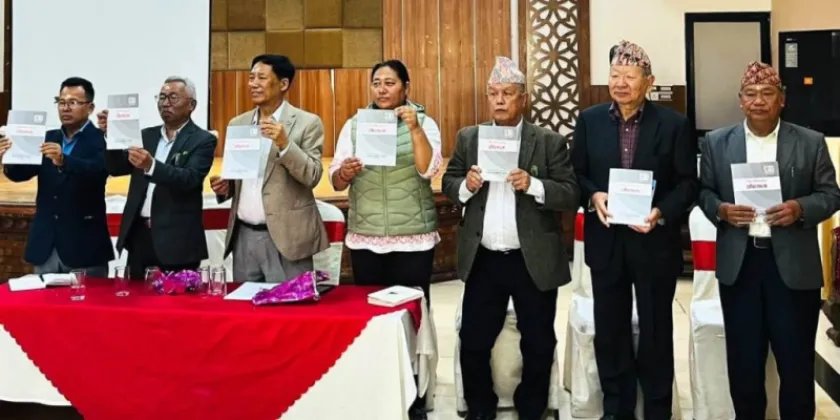
The Magar Study Centre released the 12th issue of its research publication Shodhmala at a programme held in Lalitpur on Sunday, staging the launch during the centre's 24th general assembly. The publication is dedicated to documenting and promoting study and research on the language, rituals, culture, history and identity of indigenous communities, with a particular focus on the Magar community and its heritage. Dr. Min Shreesmagar, a member of the National Indigenous Commission, formally unveiled the new issue, while Nepal Magar Association president Rakshabahadur Raikamagar was among those attending the event, as reported by Nepal Press.
A dozen editions of community scholarship
The arrival of a 12th issue is, in itself, a marker of continuity. Research publications of this kind survive only when writers keep contributing and readers keep engaging, and the fact that the Magar Study Centre has now brought out a dozen editions suggests that Shodhmala has established itself as a regular, dependable outlet for scholarship rather than a one-off project. Releasing the new issue during the 24th general assembly also underlined how central the publication has become to the centre's identity, presenting it to members at the very moment the organisation gathers to convene its assembly.
The choice of occasion carried its own significance. A general assembly is where an organisation's members come together, and placing the release there meant the 12th issue was received first by the community of researchers, activists and members with the greatest stake in it. The event in Lalitpur thus functioned simultaneously as a scholarly launch and as an organisational milestone for the centre.
What Shodhmala sets out to record
According to the centre, Shodhmala exists to document and promote study and research in five interlinked areas:
- Language - the speech, vocabulary and expression of indigenous communities
- Rituals - the rites and observances that mark community life
- Culture - the customs and practices handed down between generations
- History - the record of the community's past and its place in the country's story
- Identity - the collective sense of self that connects all of the above
Together, these fields cover what is often described as intangible heritage: knowledge that lives in speech, memory and practice rather than in monuments or archives. Publications like Shodhmala matter precisely because such knowledge is vulnerable. When a language stops being passed on to children, or when rituals are shortened or set aside, the loss is rarely sudden, but it is cumulative and difficult to reverse. Systematic documentation, carried out by and for the community itself, is one of the most reliable counters to that erosion.
Why documentation matters in Nepal
Nepal is home to a wide range of indigenous nationalities, each with its own language, customs and historical experience, and the Magar community is widely recognised as one of the country's largest indigenous groups. For communities whose knowledge has traditionally been transmitted orally, the movement of younger generations towards urban life, schooling in dominant languages and digital media has created genuine pressure on intergenerational transmission. In that context, a research publication that treats Magar language, ritual, culture, history and identity as subjects worthy of sustained academic attention performs a dual role: it preserves material for the future, and it signals to the community that its heritage belongs firmly within the realm of serious scholarship.
The institutional company present at the launch reflected that dual purpose. Dr. Shreesmagar's presence connected the release to the National Indigenous Commission, the national body concerned with the rights and welfare of indigenous nationalities, while Rakshabahadur Raikamagar's attendance linked it to the Nepal Magar Association, a principal organisation of the community. A study centre producing research, a national commission lending its standing, and a community association bringing its leadership together around a single publication illustrates how documentation work in Nepal typically advances: through the combined efforts of institutions operating at different levels.
A resource for researchers and readers alike
For scholars, Shodhmala serves as a venue in which research on Magar language and culture can appear in print, within a series that accumulates into a durable body of work over time. For educators and students, each issue adds reference material on subjects that are often thinly covered in mainstream publishing. And for the community itself, the series offers something arguably more valuable: a written, citable record of practices, expressions and histories that might otherwise survive only in memory.
The 12th issue's release in Lalitpur adds another volume to that record. As the Magar Study Centre moves past its 24th general assembly, the publication stands as a visible product of its research mandate, and its continued appearance points to the centre's ongoing commitment to documenting the language, rituals, culture, history and identity of indigenous communities in the editions still to come.


