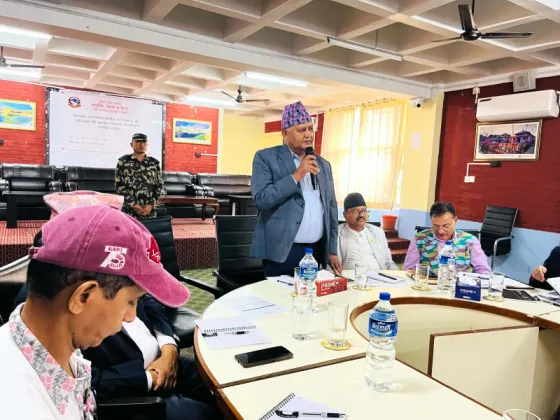
Lumbini Province Chief Minister Chetnarayan Acharya has said that the technical education curriculum must be revised to match the demand of the labour market and the needs of the private sector, warning that the current gap between classrooms and employers is costing the sector its appeal among students. He made the remarks while addressing a programme organised by the Ministry of Social Development of the Lumbini Province government in Rapti Valley (Deukhuri), Dang. As reported by RatoPati and Global Aawaj, the Chief Minister argued that technical education will regain its attraction only when it produces the skilled manpower the market is actually looking for.
A curriculum built around labour market demand
Speaking at the programme, Chief Minister Acharya said the technical education curriculum should be developed according to the demand of the labour market. In his view, courses that ignore what employers require end up serving neither the students who complete them nor the businesses that are expected to hire them. The starting point for reform, he indicated, is a curriculum that is written with the market in view rather than one that is revised only occasionally and in isolation from employers.
He placed particular weight on the private sector. According to his remarks, the needs of private enterprises should sit at the centre of curriculum design, because it is the private sector, alongside the wider labour market, that absorbs skilled graduates. Training that is disconnected from this reality, he suggested, produces credentials rather than competence.
The thrust of his address can be summed up in three linked points:
- The technical education curriculum must be revised so that it matches labour market demand.
- The needs of the private sector should guide what technical institutions teach and train for.
- The end goal is the production of skilled human resources who can be readily absorbed by the economy.
Declining student interest: a warning from the Chief Minister
A central concern in Acharya's remarks was the falling attraction of students toward technical education. He did not treat this as a mystery. In his telling, students are drifting away because the system is not producing skilled manpower according to market demand, and young people can see it. When a technical qualification does not lead to the skills or the opportunities the market rewards, the case for choosing that path weakens with every graduating batch.
The argument has a practical edge. If the mismatch persists, promotion campaigns and awareness drives will do little to bring students back, because the underlying product has not changed. Conversely, a curriculum aligned with labour market demand would give prospective students a straightforward proposition: learn what the market needs, and the market will have a place for you. It is precisely this proposition that his proposed realignment is meant to restore.
Read together with his call for curriculum reform, the diagnosis and the remedy form one piece. The decline in student attraction is the symptom; the misalignment with the labour market is the cause. Acharya's prescription addresses the cause rather than the symptom.
Linking the classroom to the labour market
Acharya stressed linking technical education with labour market demand and the needs of the private sector so that the system produces skilled human resources. The link he described works in two directions. The labour market signals which skills are in demand, and the education system responds by turning out people equipped with those skills. Where that circuit is broken, students lose interest on one side and employers are left short of workers on the other.
The private sector's stake
By naming the private sector explicitly, the Chief Minister positioned employers as more than the final destination for graduates. His framing suggests they are stakeholders in the design of technical education itself, with their hiring needs shaping what is taught and their demand for skills justifying the investment in training. For a province like Lumbini, that framing treats skills policy and economic policy as closely linked rather than separate files on a government shelf.
A provincial platform for the skills agenda
The programme was organised by the Ministry of Social Development of the Lumbini Province government, and its setting in Rapti Valley (Deukhuri), Dang, meant the Chief Minister's message was delivered through a provincial platform outside the routine confines of administrative offices. That the provincial government used the occasion to discuss the direction of technical education signals where Acharya believes the province's priorities must lie: in producing people the market can use.
His concluding message was pointed. Technical education matters to students only when it leads somewhere, and it leads somewhere only when the curriculum reflects the demand of the labour market and the needs of the private sector. Until that alignment is achieved, his argument ran, the province will continue to see both declining student interest and a shortage of the skilled human resources its economy requires.