
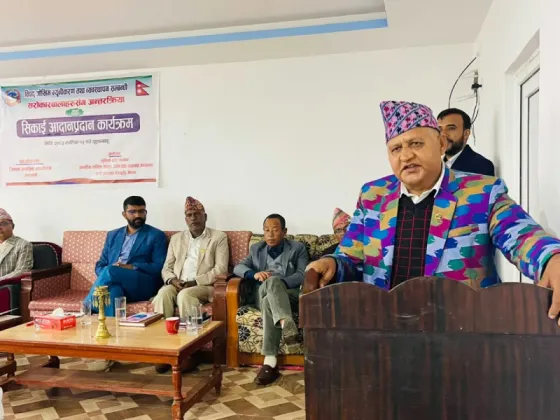
Lumbini Province Chief Minister Chetnarayan Acharya has stressed that effective coordination and preparedness among all three tiers of government and the agencies concerned are essential for disaster risk reduction and management. Speaking at an interaction and learning-sharing programme organised with stakeholders in Arghakhanchi on Friday, the chief minister said disaster management must be treated as a priority by the government, while the agencies responsible must fulfil their duties without lapse.
His remarks come at a time when efforts are underway to reduce the loss of life and property caused by disasters, which continue to claim lives and damage infrastructure across Nepal every year.
Coordination across three tiers of government
At the heart of Acharya's message was the principle that no single level of government can manage disasters alone. He emphasised that the federal government, the provincial government and local governments must work in close coordination, together with the relevant agencies involved in preparedness, rescue and relief.
Under Nepal's federal system, disaster management responsibilities are shared. The federal level frames policies and mobilises national resources, provincial governments such as Lumbini's play a coordinating and facilitating role, and local governments act as first responders when disaster strikes. In practice, weaknesses in communication or preparation at one tier can undermine the entire response chain, which is why calls for coordination from leaders such as Acharya carry practical weight.
The chief minister also made clear that the government should prioritise and invest in disaster management, while the concerned agencies carry out the responsibilities assigned to them. Addressing the gathered stakeholders, he underlined that plans and budgets must translate into concrete action on the ground if the loss of life and property is to be reduced.
Preparedness as the first line of defence
Preparedness formed the second pillar of Acharya's address. He told the gathering that effective preparedness among government bodies, agencies and communities is vital to lessening the impact of disasters when they occur.
Preparedness-focused measures are widely recognised as more cost-effective than post-disaster response. Such measures generally include:
- Risk assessment and hazard mapping at the local level
- Early warning and information-sharing systems
- Pre-positioning of relief supplies and equipment
- Community-level training, mock drills and awareness programmes
Learning-sharing interactions like the one held in Arghakhanchi are designed to bring the various agencies and stakeholders involved in disaster management onto a common platform, allowing them to exchange experiences, identify gaps and strengthen coordination before the next emergency.
Reducing losses through shared learning
The format of the programme, a learning-sharing exercise, reflects a growing recognition that lessons from past disasters must inform future planning. By bringing together stakeholders who respond to emergencies from different vantage points, such interactions aim to build the mutual understanding on which coordinated action ultimately depends.
A disaster-prone province
The setting of the chief minister's remarks is significant. Lumbini Province stretches from the hill districts of the Mahabharat range, including Arghakhanchi, through the Chure foothills and down to the Terai plains. That varied geography exposes the province to a broad range of hazards, from landslides and flash floods in the hills to riverine flooding and inundation in the lowlands.
Nepal as a whole remains highly vulnerable to natural disasters, with the annual monsoon regularly triggering landslides, floods and related incidents that displace families, destroy farmland and sever road links. Successive governments have acknowledged that investment in disaster risk reduction has not kept pace with the scale of the threat, a gap that provincial leaders have increasingly pushed to close.
Against this backdrop, the Arghakhanchi interaction carried a dual purpose: reinforcing the message that disaster management deserves political priority and budgetary support, and mobilising the stakeholders who must deliver preparedness in their respective areas.
Responsibility, investment and the road ahead
In drawing a clear line between the roles of government and agencies, Acharya framed disaster management as much a question of accountability as of resources. The government's responsibility is to prioritise and fund the sector; the responsibility of implementing agencies is to act diligently within their mandates.
For officials and communities across Lumbini Province, the chief minister's message in Arghakhanchi distils into a straightforward proposition: disasters may be unavoidable, but their human and economic cost can be sharply reduced when all three tiers of government coordinate in advance, prepare seriously and invest consistently in risk reduction.
Further details of the programme are available via Rato Pati and Nepal Press.


