
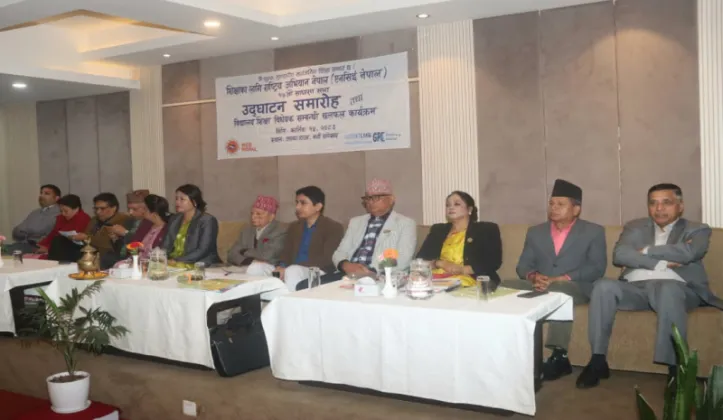
Lawmakers, policymakers, education experts and rights activists on Sunday jointly demanded that Nepal's proposed School Education Bill guarantee the constitutionally promised right to free and quality education for every child. The call was raised at a debate on the draft legislation held in Kathmandu on the occasion of the 17th annual general assembly of the National Campaign for Education (NCE) Nepal, where speakers united around a central message: public education is the responsibility of the state and must be delivered through close coordination among the federal, provincial and local governments.
A Debate Timed With NCE Nepal's Annual Assembly
The debate offered a shared platform for those who will shape the legislation and those who will live with its outcomes. According to reports by Gorkhapatra Online and Khabarhub, the discussion drew lawmakers and policymakers alongside education experts and rights activists to examine the School Education Bill and the direction it should take.
The timing carried its own significance. The event was organized as NCE Nepal convened its 17th annual general assembly in the capital, bringing the campaign's members and partners together around one of the most consequential policy questions in the education sector. The participation of lawmakers and policymakers gave the discussion a direct line into the legislative process, while the presence of experts and rights activists ensured that the concerns of communities and classrooms were firmly on the table.
Turning a Constitutional Promise Into Law
At the heart of the debate was the constitutional guarantee itself. Nepal's constitution promises the right to free and quality education, and participants pressed for the School Education Bill to be crafted so that this promise is translated into enforceable law rather than left as a statement of intent. The demand for a firm guarantee reflected concern that, without clear and binding provisions, a constitutionally protected right could remain confined to paper.
In practical terms, free education means the state bears the cost of schooling so that no child is excluded because of a family's ability to pay. Quality education, in turn, points to the standards and conditions that allow children not simply to attend school but to learn meaningfully. Together, these two ideas formed the backbone of the demand voiced in Kathmandu on Sunday, as speakers argued that the bill must protect both access and the substance of learning.
Key Expectations From the Bill
The expectations highlighted at the debate can be summed up as follows:
- A firm, enforceable guarantee of free education, so that cost never becomes a barrier to a child's schooling
- Strong provisions on quality education, ensuring the right covers meaningful learning and not just enrollment
- Clear recognition of public education as the responsibility of the state, with the government answerable for how schools serve children
- Effective coordination among the federal, provincial and local governments, so that shared duties translate into services rather than confusion
Together, these demands frame the test that many at the debate appeared to set for the legislation: whether it can convert a broad constitutional assurance into concrete, enforceable rights for children across the country.
Public Education as a State Responsibility
A recurring theme throughout the discussion was the role of the state. Participants stressed that public education must be the responsibility of the state, with the government, rather than individual families, carrying the primary obligation to secure every child's right to learn. This position placed the state's accountability at the centre of the bill, with speakers linking it to the need for legislation strong enough to hold authorities answerable for the performance of public schools.
The emphasis also speaks to the wider purpose of the proposed law. If the state is the guarantor of public education, then the bill becomes the instrument through which that guarantee is organized, resourced and monitored. For the rights activists and experts present, the strength of that instrument is what will determine whether children in every part of the country receive the education the constitution promises them.
Coordination Across Three Tiers of Government
Participants equally stressed that the responsibility for education is shared. They underlined that delivering free, quality schooling requires coordination among the federal, provincial and local governments, the three tiers through which Nepal's federal system operates. School education touches all three levels, and the debate made the case that the bill should ensure the tiers work in concert rather than in parallel.
Clear coordination, speakers indicated, is essential so that constitutional responsibilities are implemented smoothly at every level, from national policy down to the classroom. Gaps or overlaps between governments, the argument ran, ultimately land on the shoulders of children and their families, which is why the proposed legislation must set out how the three levels will cooperate in practice.
The Sunday debate adds a strong collective voice at a time when the proposed School Education Bill is under active national discussion. For the lawmakers, experts and activists who gathered in Kathmandu, the measure will ultimately be judged by a simple standard: whether it delivers the free, quality education that Nepal's constitution has already promised to its children.


