
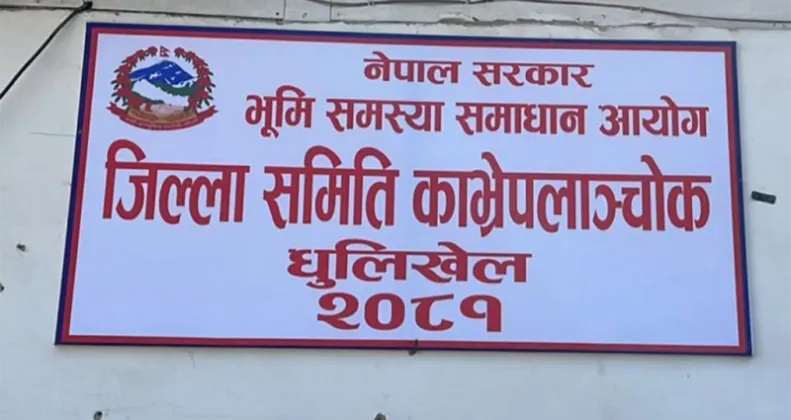
Landless Dalits, squatters and unmanaged settlers in Kavrepalanchok district are yet to receive the land they have long awaited, as local governments have failed to prioritise their applications and the district committee under the government-formed Land Problem Resolution Commission has shown little interest in cases that should come from the local level. Reports published by Nepal Press and Ratopati detail how this combined neglect has stalled land provision for some of the most vulnerable residents of the Kavre district in Bagmati Province, leaving landless families in a prolonged wait for ownership that shows no clear timeline.
Local levels have not prioritised applications
The core of the problem, according to both reports, lies at the very first step of the land resolution process. Applications from landless families are expected to be initiated and forwarded by their respective local governments. Municipalities and rural municipalities are meant to identify genuine landless residents, process their applications and send them upward for verification and decision.
In Kavrepalanchok, however, local governments have not treated these applications as a priority. Landless Dalits, squatters and unmanaged settlers who have approached their local representatives have found little momentum behind their cases. Because the applications are not being actively moved from the local level, they are not reaching the district committee in the volume or with the urgency required for the commission's work to progress.
Where the process breaks down
The structure of the commission's work makes local-level engagement indispensable. The district committee under the Land Problem Resolution Commission cannot, on its own, generate applications. It depends on municipalities and rural municipalities to bring forward the cases of the landless within their areas. When local levels show indifference, the entire chain stalls, not because of any legal barrier, but because the administrative groundwork is simply not being done.
District committee shows little interest
The reports also point to inaction within the district committee itself. The committee, which operates under the government-formed Land Problem Resolution Commission, has displayed little interest in the applications that should come from the local level. Rather than following up with municipalities, pressing for pending files and facilitating the progress of landless families' cases, the committee has remained largely passive.
This dual neglect, involving disengaged local governments and an inactive district committee, has meant that even families whose eligibility might otherwise be established are left waiting with no movement on their applications. The delay is therefore not the result of a single weak link, but of an entire coordination chain failing to function.
Why the delay cuts deep for landless families
For the families awaiting land in Kavre, the stakes are high. Land ownership in Nepal underpins access to secure housing, agricultural livelihoods, credit and a range of services and entitlements tied to proof of ownership. Squatters and unmanaged settlers frequently live for extended periods on land they do not legally own, leaving them exposed to eviction and unable to make long-term investments in their homes or farms.
The situation is particularly acute for landless Dalits, who are among Nepal's most socially and economically marginalised communities. For many Dalit families, landlessness is both a consequence of longstanding discrimination and a continuing barrier to equality, which gives the delayed delivery of land a social dimension that goes beyond administration.
Landlessness has been one of Nepal's most persistent policy challenges, and successive governments have set up commissions to identify the landless and distribute land. The present Land Problem Resolution Commission was formed by the government with precisely that mandate: to resolve the problems of landless Dalits, squatters and unmanaged settlers by verifying their cases and providing land ownership. The experience in Kavre illustrates how easily that mandate can be frustrated when the local structures it relies on do not engage, even as other tiers of government await files that never arrive.
What needs to change
The reports make clear that the solution lies in activation rather than redesign:
- Local governments in Kavrepalanchok must prioritise the collection and forwarding of applications from landless Dalits, squatters and unmanaged settlers.
- The district committee under the Land Problem Resolution Commission must take a proactive interest in pending applications and coordinate with municipalities to move files forward.
- The concerns of the landless need to be treated as a governance priority rather than a low-level administrative formality.
Until local levels and the district committee begin to treat these applications with the seriousness they require, landless families in Kavrepalanchok will continue to wait, and the commission's promise of land for the landless will remain, for them, undelivered.


