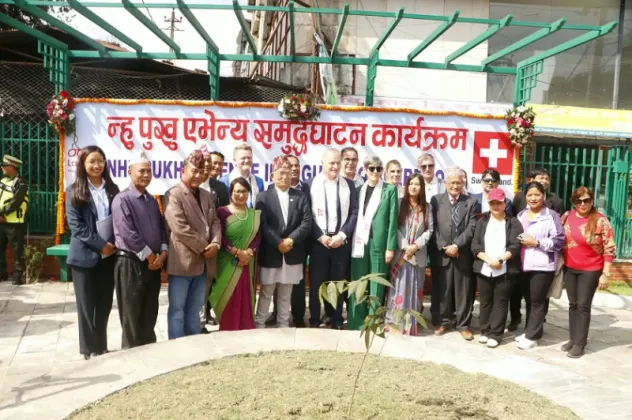
Lalitpur Metropolitan City has inaugurated Nhu Pokhu Avenue, a newly built public park developed alongside the Nhu Pokhari pond at Lagankhel with support from Switzerland, giving residents of the Kathmandu Valley city a fresh public space in one of its busiest commercial neighbourhoods. The project brings together infrastructure, environmental and cultural elements under a single foreign-assisted scheme, and the opening has been described in reports as a notable new addition to the city's public spaces.
A New Public Space at Lagankhel
Lagankhel is among the most recognisable hubs of Lalitpur Metropolitan City, functioning as a commercial centre and a major transit point for people moving through the southern part of the Kathmandu Valley. It is at this busy junction, beside the Nhu Pokhari pond, that the metropolitan city has developed the new avenue park, a project reported by Ratopati as a fresh public space for Lalitpur.
The essential facts of the announcement are as follows:
- Project name: Nhu Pokhu Avenue
- Type: Public park
- Location: Lagankhel Chowk, beside the Nhu Pokhari pond, in Lalitpur Metropolitan City
- Assistance: Support from Switzerland
- Character: A project combining infrastructure, environmental and cultural elements
- Status: Inaugurated and reported as a new public space
With the inauguration completed, the site now functions as a formally opened public amenity. Its setting alongside an existing pond connects the new facility to a landmark that local residents already know well, anchoring the park within the everyday geography of Lagankhel rather than introducing an isolated piece of infrastructure.
Infrastructure, Environment and Culture in One Project
Three Strands Brought Together
According to the report, the project was conceived to combine three dimensions, an approach that shapes how the park can serve the city:
- Infrastructure: The park represents municipal construction delivered at the neighbourhood level, converting a site at Lagankhel Chowk into a formal public facility under the banner of an avenue.
- Environment: Its placement beside the Nhu Pokhari pond ties the new development to the water body and its surroundings, keeping the existing natural feature at the centre of the space rather than at its margins.
- Culture: The name itself draws on local linguistic heritage, with "nhu" meaning new in the Newari language and "pukhu" the Newari word for pond, echoing the neighbouring Nhu Pokhari, whose name pairs the same word with the Nepali term "pokhari."
The combination matters because public spaces in dense urban areas rarely serve a single purpose. A park can operate as civic infrastructure, as a refuge tied to water and greenery, and as a bearer of local identity all at once. By framing Nhu Pokhu Avenue in these three terms from the outset, the metropolitan city has signalled that the park is intended to work on all three levels for the people of Lalitpur.
Swiss Support and Foreign Assistance
The report identifies Switzerland as the source of support for the park, placing the project in the wider category of foreign-assisted municipal development in Nepal. Switzerland has long been a development partner of Nepal, and international cooperation in the country has traditionally extended across areas that include local governance, urban development and environmental management.
For a metropolitan city such as Lalitpur, assistance directed at a neighbourhood-scale project like a public park illustrates how foreign support can reach beyond large national programmes and translate into visible amenities at the local level. The Lagankhel park, built with Swiss backing and delivered by the municipal government, now stands as a concrete example of that model of cooperation between a local government and an international partner.
Open Space in a Growing City
The opening of Nhu Pokhu Avenue arrives against the broader backdrop of rapid urbanisation across the Kathmandu Valley, where cities including Lalitpur have seen built-up areas expand and shared open space come under sustained pressure. In dense, commercially active areas such as Lagankhel, a dedicated public park offers residents and visitors a place to pause, gather and spend time outdoors amid the demands of daily urban life.
The park's pond-side location also connects it to an older inheritance. Ponds have historically been part of the civic fabric of Newar settlements in the valley, serving as shared assets around which community life was organised. By building its new avenue park alongside Nhu Pokhari, Lalitpur Metropolitan City has linked that inherited landscape to a contemporary public amenity, extending a long-standing relationship between the city's water bodies and its public spaces.
With the inauguration complete, Nhu Pokhu Avenue becomes the newest public space in Lalitpur, delivered through a partnership between the metropolitan city and Switzerland and framed around infrastructure, environmental and cultural values. For the people of Lagankhel, the immediate significance is straightforward: a busy corner of the city now has a park of its own, and the wider urban community has a fresh example of how international assistance and local implementation can come together in the shape of a public park.