
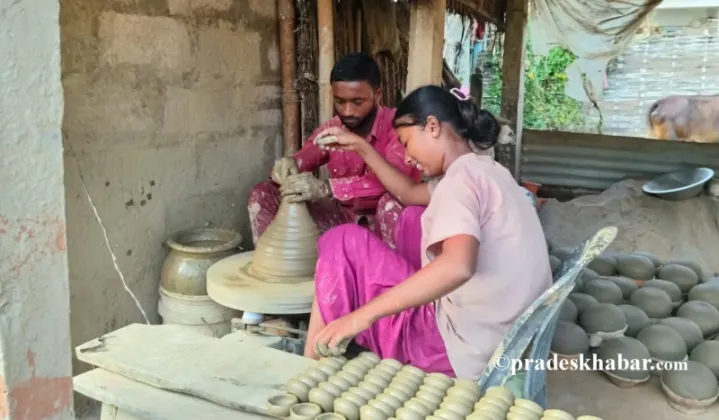
With the festival of lights and the great sun-worship of Chhath drawing near, the Kumhar community, the Tarai's traditional potters, is working at full pace to have its earthenware ready in time. Potters across Sunsari district, from Inaruwa, the district headquarters, to Koshi, Bhokraha, Harinagar, Dewanganj and Gadhi, are busy preparing clay pots for Tihar and Chhath, moulding the vessels that households across the area will need for the celebrations in the days ahead.
According to reports carried by Pradesh Khabar, Nepal Views and Nepal Samaya, members of the community have divided the work among themselves: some are kneading clay while others are shaping pots. Behind the flurry of activity lies a single, shared goal, to supply consumers with clay vessels before the festivals begin.
A festival rush across the district
The pre-festival activity has been reported from potter settlements spread across Sunsari, a Tarai district in Koshi Province of eastern Nepal. The localities named in the reports include:
- Inaruwa, the district headquarters
- Koshi
- Bhokraha
- Harinagar
- Dewanganj
- Gadhi
In each of these places the routine is much the same. Some members of the Kumhar community spend their days kneading clay into a workable consistency, while others give that clay its final form, turning out pots and other earthen vessels. Everything is directed at one deadline: the arrival of Tihar and, soon after it, Chhath, the two festivals that together bring the year's greatest demand for the potter's wares.
For the Kumhars, the weeks before the festivals are therefore the most important of the calendar. Households that may not buy clay goods through the rest of the year look for earthen lamps, pots and vessels when Tihar and Chhath approach, and it is this seasonal wave of demand that the potters of Sunsari are now racing to meet.
Why clay sits at the heart of the festivities
Tihar, also known as Yam Panchak or the festival of lights, unfolds over five days in the Nepali month of Kartik, which usually falls in October or November. Homes are cleaned, decorated and illuminated with oil-fed clay lamps throughout the festival, from Kaag Tihar, when crows are honoured, through Laxmi Puja, Goru Puja and Govardhan Puja, to Bhai Tika, which brings the festivities to a close. For many families, the celebration is simply incomplete without a stock of earthen lamps and vessels, and potters are the people who make that possible.
Chhath, observed within days of Tihar's conclusion, is dedicated to the Sun God and Chhathi Maiya and is celebrated with particular devotion across the Tarai belt, including Sunsari. Devotees fast, gather at rivers and ponds, and make offerings to the setting and the rising sun. Earthen lamps and clay pots are integral to these rituals, which places the Kumhar community's handiwork at the centre of a second major celebration almost immediately after the first.
The back-to-back timing of the two festivals is what gives this season its special intensity for potters. Rather than a single burst of demand, the community must prepare for a sustained one, with buyers seeking clay goods for Tihar's lamps and Chhath's offerings within the same short window.
A hereditary craft in its busiest weeks
For the Kumhars, pottery is not a seasonal occupation but a hereditary trade, a craft handed down within the community over generations. The work now under way across Sunsari follows the age-old rhythm of the craft: clay is kneaded until soft and even, shaped by hand on the wheel, and then dried and finished into vessels fit for the kitchen or the shrine.
Pottery is among the oldest of human crafts, and in the Tarai the Kumhar community has kept the wheel turning for generations, supplying households with clay pots and utensils in ordinary times and festival goods when the calendar demands them. The reports from Sunsari show that division of labour in action, with some hands at the clay pit and others at the wheel, each step of the work moving in step with the next so that finished wares are ready before the first lamps of Tihar are lit.
It is precisely this combination of tradition and timing that makes the pre-festival weeks the busiest stretch of the potter's year. The shared goal expressed by the community is a practical one: that no consumer who wants a clay vessel for the festivals should go without one.
Keeping the wheel turning
As Tihar lamps begin to glow in doorways and Chhath devotees make their way to the water's edge, the work of the Kumhars of Sunsari will be present in the lamps and pots that punctuate the rituals. For now, though, there is little time to look that far ahead. In Inaruwa, Koshi, Bhokraha, Harinagar, Dewanganj and Gadhi, hands remain deep in clay and the wheels keep spinning, as the district's potters press on with their shared mission of delivering clay vessels to consumers in time for Tihar and Chhath.


