
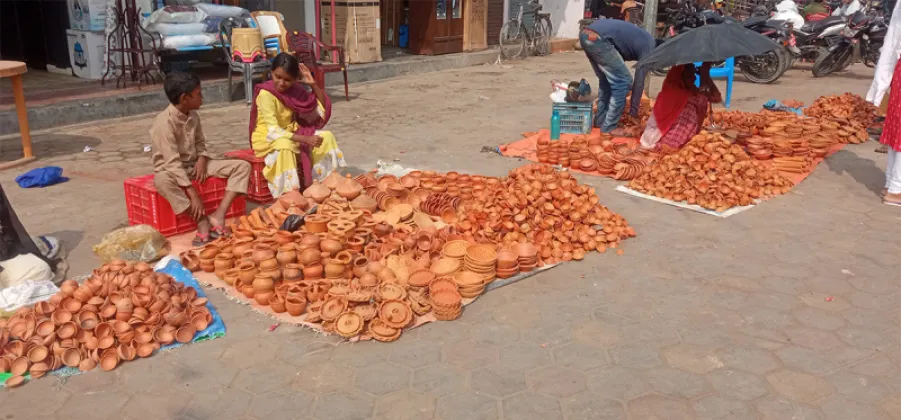
With Diwali and Chhath just around the corner, the Kumal potters of Khajuri in Janaknandani Rural Municipality-4, Janakpurdham, are working from early morning until late evening to meet the festival season's demand for traditional clay ware. In courtyards across the settlement, members of the Kumal community are busy shaping and drying earthen lamps, pitchers and pots, the very items that households across the historic city will light, fill and offer during the festivals ahead.
The festival weeks are the busiest stretch of the year for these potters, whose trade in clay goods picks up sharply around Diwali and Chhath before slowing for the rest of the year, a cycle that has left the community worried about sustaining a year-round livelihood from their craft.
Festival rush fills the potters' courtyards
In Khajuri, the working day now begins with the first light and stretches late into the night. Potters of the Kumal community spend their days shaping clay into a wide range of festival ware and laying the finished pieces out in their yards to dry, racing to build up stocks as orders gather pace ahead of the two festivals.
The wares coming out of the courtyards this season include:
- Diyo, the clay lamps traditionally lit in homes, courtyards and along the ghats during the festival of lights and the Chhath rituals
- Kalash, the sacred pitchers used in worship and offerings
- Ghaito and dhupauro, used for lamps and incense during the festivities
- Handi and matka, earthen pots long associated with cooking and storing water
- Hatti, kosiya and kurwar, traditional pieces crafted for ritual and household use
Together, these items form the backbone of the potters' festival trade, with demand rising in the run-up to Diwali and Chhath, when families across Janakpurdham prepare to illuminate their homes and make ritual offerings.
Local media reports, including coverage by Nagarik News and Rato Pati, describe the courtyards of Khajuri buzzing with activity as the community works dawn to dusk to keep pace with the seasonal rush.
Lamps and vessels at the heart of the celebrations
Clay holds a central place in both festivals. During Diwali, the festival of lights, households traditionally light rows of diyos to mark the victory of light over darkness, and the small earthen lamps remain a preferred choice for many families across Madhesh. During Chhath, the festival dedicated to the Sun god, devotees gather at riverbanks and ponds, where lit lamps and ritual vessels accompany the offerings made over the festival's observances.
That close connection between the festivals and earthenware is what makes these weeks so decisive for the Kumal potters. The diyo, kalash and other items produced in Khajuri are not decorative extras but essentials for the celebrations, giving the community its most reliable stretch of business in the entire year.
Booming season, lean months beyond
The pickup in trade around Diwali and Chhath, however, stands in sharp contrast to the rest of the calendar. According to the reports, business in clay pots remains slow outside the festival season, and the Kumal community of Khajuri is worried about how it will sustain itself through the year.
For a community that has depended on pottery for generations, the seasonal pattern means income is concentrated in a handful of busy weeks around the festivals, while the remaining months bring little trade and uncertain earnings. The worry about year-round livelihood hangs over the settlement even as its courtyards stay full of work.
Long hours now, uncertain earnings later
The potters' routine in the current season reflects both the opportunity and the pressure they face. Working from early morning until late evening, shaping wares and drying them in their yards, the Kumal artisans of Janaknandani Rural Municipality-4 are making the most of the demand while it lasts.
For now, the yards of Khajuri are lined with rows of diyos, kalash and pots awaiting the homes and ghats of Janakpurdham. The lamps and vessels being finished today will glow in homes and along the waterfronts during Diwali and Chhath, even as the potters look ahead to the slower months that follow, when the festival demand fades and the community must again reckon with the question of its year-round survival.


