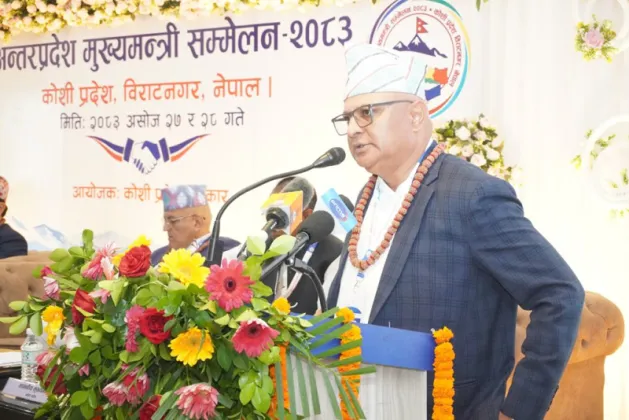
Koshi Province Chief Minister Hikmat Kumar Karki said Nepal’s federal system needs a clearer constitutional division of powers to work effectively, describing the current distribution of provincial powers as “colour-blind” at an inter-provincial chief ministers’ conference in Biratnagar on October 13. He defended the provincial structure as the true identity of federalism and called for united action across the federal system. Karki also argued that provinces should not be dismissed as “white elephants,” according to reports by Onlinekhabar and Ratopati.
Karki calls for clearer constitutional powers
Karki’s remarks centred on the need to clarify how powers are divided under the Constitution. He said further definition was necessary if federalism was to become effective, pointing to the present distribution of provincial authority as a problem. His description of it as “colour-blind” conveyed his criticism of a system in which, in his view, provincial powers are not sufficiently clear.
The chief minister did not present federalism as a structure that should be abandoned. Instead, he argued that its operation needs to be strengthened through greater clarity about the constitutional division of responsibilities. His comments placed the question of provincial authority at the centre of the discussion among provincial chief ministers in Biratnagar.
The call for clarification is significant to the debate because the constitutional arrangement assigns powers within a federal system, while Karki said the way provincial powers are currently distributed needs further definition. His argument was that the system cannot be fully effective unless the responsibilities and authority of provinces are made clearer. The remarks thus focused on how federalism functions in practice, rather than on rejecting the provincial tier of government.
‘Provinces are the real identity of federalism’
Karki defended the provinces as the real identity of federalism, pushing back against criticism that provincial governments are costly or unnecessary. He said calling provinces “white elephants” was wrong, a position also reflected in Ratopati’s report on his remarks. For Karki, the provincial structure is not an optional addition to federalism but a defining part of it.
His defence came alongside his criticism of the current distribution of powers. Those points are connected: Karki called for provinces to be recognised as essential to the federal system while also saying the constitutional arrangement should be clarified to make that system work effectively. His remarks did not suggest that maintaining provinces alone would resolve federalism’s problems. Rather, he emphasised both the importance of the provincial tier and the need to make its powers clearer.
The “white elephants” label is a pointed way of questioning the value of provincial institutions. Karki’s response was to reject that characterisation and insist on the provinces’ place in the country’s federal identity. By making that case at an inter-provincial gathering, he linked the defence of provincial governments to a wider discussion about how federalism should operate across Nepal.
Call for united federal action
Karki also called for united action at the federal level. His appeal accompanied his argument that the constitutional division of powers needs clarification and that provinces should be recognised as central to federalism. The reports of his remarks describe a push for a more effective system through clearer powers and coordinated action, rather than a rejection of the federal structure.
The conference in Biratnagar provided a setting for provincial chief ministers to discuss issues affecting the federal system. Karki used the occasion to draw attention to what he sees as a lack of clarity around provincial authority and to defend the role of provinces against arguments that they are an unnecessary burden. The central message of his remarks was that federalism needs both a clearer division of constitutional powers and recognition of provinces as an essential part of its identity.
His comments add to the ongoing discussion over how Nepal’s federal arrangement should function. Karki’s position, as reported by Onlinekhabar and Ratopati, was that the way forward lies in clarifying provincial powers and acting together across the federal system. He maintained that provinces are fundamental to federalism, even as he called for changes in how their constitutional authority is understood and applied.