
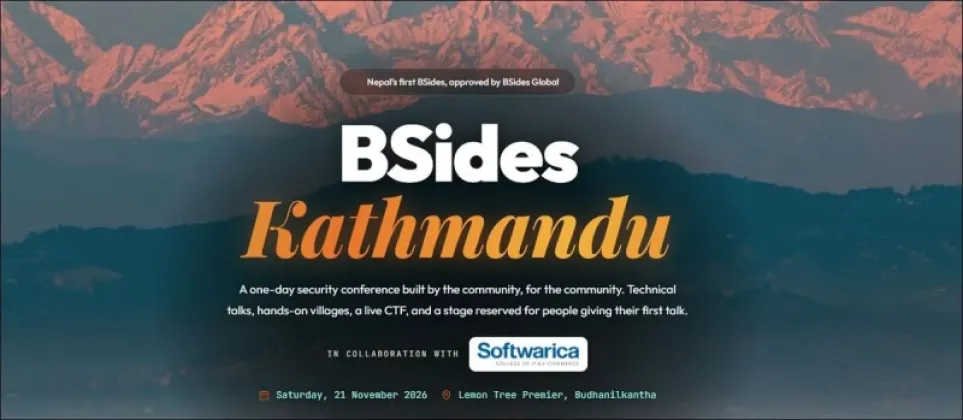
Kathmandu is preparing to host its first-ever one-day cybersecurity conference, the BSides Kathmandu Cybersecurity Conference, this November, adding a dedicated security-focused gathering to the capital's technology calendar. The event, also referred to as 'Besides Kathmandu 2026', is being organized around four broad themes: science, education, business and the economy. According to a report by Ratopati, the conference will be the first of its kind to be staged in Kathmandu, bringing cybersecurity discussions into a focused, single-day format.
A First-of-Its-Kind Gathering in the Capital
The significance of the November conference lies in its first-ever tag. While Kathmandu regularly hosts a steady stream of technology-related events covering software, innovation and digital services, the BSides Kathmandu Cybersecurity Conference stands out because it is being described as the first cybersecurity conference of its kind in the city, and the first to be delivered entirely within a single day. For the community of students, IT professionals, entrepreneurs and researchers in Nepal, that combination of novelty and accessibility gives the event a distinct place in the local calendar.
The name itself carries two identifiers. The event is formally titled the BSides Kathmandu Cybersecurity Conference, while announcements have also referred to it as 'Besides Kathmandu 2026'. The '2026' in the alternate name points to the edition of the conference being planned, while 'Kathmandu' anchors the event firmly in the Nepali capital, where it is scheduled to take place in November.
A single-day format is a practical foundation for a first edition. It allows organizers to present a complete, self-contained programme, and it asks attendees for only one day of commitment, which can make participation easier for people balancing work, studies and other responsibilities.
Four Themes at the Heart of the Conference
What distinguishes the conference's framing is its deliberate breadth. Rather than limiting itself to narrowly technical topics, the event is being themed around four interlocking areas: science, education, business and the economy. According to the announcement, these four pillars define the scope of the conversation the conference intends to host.
- Science: this theme points to the research and technical foundations of cybersecurity, an area where rigorous, evidence-based work underpins everything from secure systems to new defensive approaches.
- Education: the education pillar speaks to learning, skill-building and awareness, reflecting the role that training and knowledge-sharing play in preparing people to understand and manage digital risks.
- Business: the business theme acknowledges that organizations of every size now operate in environments where digital security is a practical, everyday concern rather than a distant abstraction.
- Economy: the economic dimension connects cybersecurity to the wider financial and commercial life of the country, where digital transactions and online services increasingly shape growth and daily commerce.
Taken together, the four themes signal an intent to treat cybersecurity not as an isolated technical specialty but as a subject that touches classrooms, companies, markets and the broader economy alike. That framing broadens the event's relevance well beyond a purely technical audience and invites participation from educators, business owners, policymakers and students alongside security practitioners.
What the One-Day Format Offers Attendees
As a one-day conference, the event is structured to deliver its programme in a compact window. This format is a common choice for first-time gatherings because it concentrates talks, discussions and networking into a single, manageable day, giving newcomers an approachable entry point into a specialized field.
For Kathmandu's technology community, the single-day structure lowers many of the practical barriers that often keep people away from longer events. Students can attend without disrupting their studies, working professionals can participate without committing multiple days, and organizations can send team members without a significant investment of time. That accessibility gives the first edition a broad potential audience and aligns naturally with the conference's education theme, since first-time events of this kind often serve as an introduction to a field for many who attend.
The one-day model also creates a shared, concentrated moment for the local community. Rather than spreading conversations across several days, a single-day conference brings participants together at the same time, which can make discussions, exchanges and relationship-building more immediate and visible.
Looking Ahead to November
At this stage, the announcement confirms the essentials: the event's name, its one-day duration, its November timing, its location in Kathmandu and its four-part thematic focus. Details such as the venue, the speaker line-up and registration arrangements were not part of the initial report, and those specifics are expected to become clearer as November approaches. Interested participants and observers can follow updates through coverage such as the original report.
As the first conference of its kind in the city, the BSides Kathmandu Cybersecurity Conference arrives at a moment when conversations about digital security are increasingly relevant to how people learn, run businesses and take part in the economy. By framing its programme around science, education, business and the economy, the event is positioning cybersecurity as a shared, cross-cutting concern rather than a niche one. For now, the capital's first cybersecurity conference stands scheduled for November, set to bring these discussions together under a single roof, if only for a day.


