
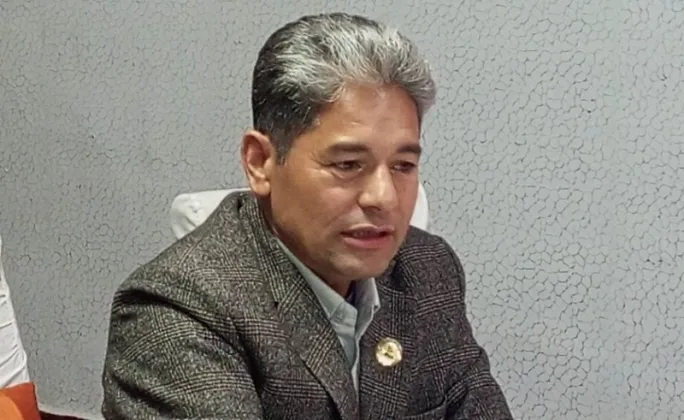
Karnali Province Chief Minister Mangal Bahadur Shahi has said that both the province's native produce and its soil must be protected, underlining that the region's agricultural identity depends on safeguarding its indigenous crops and the fertility of its land. Shahi made the remarks during an inspection visit to the Agriculture Research Centre Dasharathpur in Lekbeshi Municipality of Surkhet district, where he also held discussions with officials of the centre on the state of agricultural research and production in the province. The chief minister's visit and his comments were reported by Rato Pati and Nagarik News.
Shahi inspects Agriculture Research Centre Dasharathpur
Chief Minister Shahi travelled to Dasharathpur, in Lekbeshi Municipality of Surkhet, to inspect the Agriculture Research Centre and to see for himself the work being carried out at one of the province's key agricultural research institutions. During the visit, he engaged in discussions with the centre's officials, reviewing matters related to agricultural research and the technologies being developed for farmers in Karnali.
The inspection visit reflects the emphasis the provincial leadership has placed on agriculture as a core area of Karnali's economy. Research centres such as the one at Dasharathpur play a central role in generating the techniques, seed varieties and farming practices suited to the province's difficult terrain and diverse climatic conditions, and direct engagement between the provincial government and such institutions is considered important for aligning research with policy priorities.
Guarding the land and its produce
In his discussions with officials, Chief Minister Shahi underlined that Karnali's indigenous products and its soil are assets that must be protected. His message was clear: the province's native produce, which has been cultivated and sustained by local farmers for generations, cannot be allowed to disappear, and the soil that supports it must be preserved for the future.
The chief minister's remarks carry weight in a province where agriculture remains central to household livelihoods. Karnali, the largest of Nepal's seven provinces by area, is marked by mountainous and hilly terrain, and its farmers have long relied on locally adapted crops and traditional practices. Protecting indigenous varieties and maintaining soil health are seen as essential to ensuring that farming in the province remains viable and that the distinctiveness of Karnali's produce is maintained.
Push for organic compost and phasing out chemicals
Alongside his call to protect native produce and soil, Shahi asked for the development of new technology to increase the use of organic compost fertiliser in the province. He further stressed that chemical fertiliser and pesticides should be fully replaced in Karnali, a directive that points towards making the province a centre of organic farming.
Organic compost fertiliser, produced from animal waste, crop residue and other farm-based materials, improves soil structure and fertility while reducing farmers' dependence on purchased inputs. Increasing its use would require both technical innovation and practical support so that farmers can prepare and apply compost at scale. Shahi's call for new technology in this area suggests he expects research institutions such as the Dasharathpur centre to take the lead in developing and promoting suitable methods.
The directive to fully replace chemical fertiliser and pesticides, if carried through, would mark a significant shift in farming practice across the province. Chemical inputs are commonly used to raise short-term yields, but their overuse is associated with declining soil health, contamination of water sources and residues in food. A complete transition away from them would depend on the availability of affordable organic alternatives, technical guidance for farmers and coordination between the provincial government, research bodies and the farming community.
What the directive means for Karnali's farming
The chief minister's emphasis on organic farming aligns with the wider argument that Karnali holds natural advantages for organic agriculture. The province's relatively remote geography and traditional farming systems mean that many of its fields have seen limited chemical use compared with more intensive farming areas of the country. Supporters of organic transition argue that this positions Karnali's produce to command recognition for purity and quality, provided the soil itself is kept free of chemical dependency.
Protecting indigenous products also carries cultural and economic significance. Native crops and local varieties have adapted over time to Karnali's altitude, rainfall patterns and soil conditions, making them more resilient in the face of the province's harsh environment. Preserving these varieties, alongside the soil they grow in, helps maintain biodiversity and keeps alive farming knowledge passed down through generations of Karnali's farmers.
For institutions like the Agriculture Research Centre Dasharathpur, the chief minister's directive effectively sets a research agenda: developing technologies that support compost-based farming, reduce reliance on external chemical inputs and strengthen the production of local crops. The centre's work in this direction would be a practical follow-up to the message Shahi delivered during his visit.
A signal of provincial policy direction
Shahi's remarks at Dasharathpur indicate that the protection of native produce and soil, together with a shift to organic inputs, is likely to feature prominently in the provincial government's agricultural thinking. The call places responsibility on both policymakers and researchers to translate the vision into concrete programmes that farmers can adopt on the ground.
The visit to Surkhet, home to the provincial capital Birendranagar, and the chief minister's direct dialogue with research officials signal an intent to connect high-level policy with the institutions expected to deliver it. Whether Karnali achieves the full replacement of chemical fertiliser and pesticides that Shahi has called for will depend on the pace at which new technologies are developed and the support extended to the province's farmers in the years ahead.


