
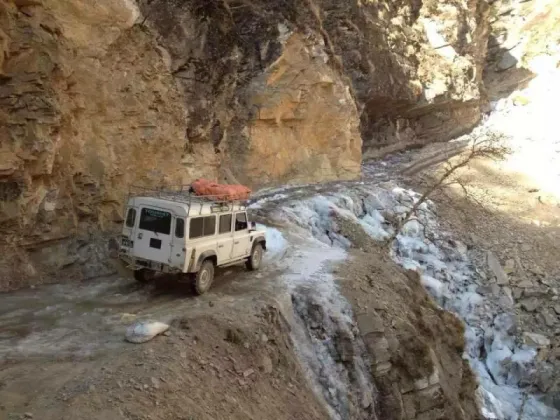
The Jomsom-Korala road in Mustang has reopened to traffic after repair crews restored the stretch that had been blocked by a landslide at Baragung Muktikshetra-3 Chhailo, the office overseeing the route confirmed. The disruption followed heavy rain that set in from Friday night, a downpour linked to Cyclone Arnab. Tejaswi Sharma, project chief of the Beni-Jomsom-Korala road, said the damaged section was brought back into operation by filling soil and rebuilding it with gabion walls, allowing vehicles to move again immediately after the works were completed.
Landslide brought traffic to a standstill
The landslide struck at Chhailo in Baragung Muktikshetra-3, pushing debris across the carriageway of the Jomsom-Korala road and halting movement along the affected section. As RatoPati reported, operation of the road was disrupted due to the rain, leaving vehicles unable to pass through the blocked point until repairs could be carried out.
What made the failure particularly notable was the history of the site. The stretch damaged by the downpour had previously been upgraded with gabion walls, the protective structures used to hold soil in place and shield road embankments from water damage. Despite that reinforcement, the intensity of the overnight rain proved enough to trigger a slide that covered the road, underscoring how vulnerable hillside alignments remain when saturation is severe.
The key points of the incident and response can be summarised as follows:
- Location: Chhailo, Baragung Muktikshetra-3, Mustang
- Cause: Heavy rain beginning Friday night, linked to Cyclone Arnab
- Damage: Landslide covering a section previously upgraded with gabion walls
- Repair: Soil filling and gabion wall reinforcement carried out by the Beni-Jomsom-Korala road project
- Status: Road reopened, with traffic resuming immediately
Rainfall linked to Cyclone Arnab
The downpour that began on Friday night was attributed to Cyclone Arnab, according to the details carried by RatoPati. Weather systems of this kind are closely watched in Nepal because the moisture they carry can produce sustained showers well beyond their immediate path, and hill districts such as Mustang feel the effects on slopes and waterways.
Rain of that kind poses a familiar problem for roads cut into mountain terrain. When soil and rock above an alignment absorb heavy rain, their weight increases and their grip weakens, and sections that appear stable in dry weather can fail suddenly. That is the sequence officials described at Chhailo, where a stretch that had been reinforced with gabion walls still gave way under the force of the rain. Rainfall that begins overnight also presents particular difficulties for road crews, as slides may be discovered only when light returns and vehicles attempt the route.
Gabion wall repairs restore the carriageway
The response focused on the technique already familiar at the site. Sharma said the road was restored by filling soil with gabion walls, the same method that had been used in the earlier upgrade of the section. Gabion walls are built from wire-mesh baskets filled with stone, stacked to form retaining structures that hold slopes in place while still allowing water to drain through, a combination that makes them a standard choice for maintaining mountain roads in Nepal. Because the baskets are filled on site with locally available stone, repairs can be carried out relatively quickly once crews and materials reach a slide, which helps explain how the Chhailo stretch was restored in time for traffic to resume immediately.
Once the soil filling and reinforcement were in place, the carriageway was brought back to a passable state and vehicles were able to use the route again without a further waiting period. Sharma's statement indicated the priority was to get traffic moving again along the corridor as quickly as possible after the blockage.
A key corridor in Mustang
The Jomsom-Korala road falls under the Beni-Jomsom-Korala road project, the body responsible for the route and the office through which Sharma spoke. For a district with a limited road network, a single blocked point can suspend movement along the corridor until crews reach the site, which is why the quick restoration of the Chhailo section mattered to users of the road. The project chief's account, carried by RatoPati, provided both the method of repair and the confirmation that traffic had resumed.
Corridors of this kind face repeated tests during periods of intense rain, and maintenance agencies typically respond with rapid repair works to restore connectivity. Travellers on hill roads are generally advised to remain alert in wet conditions, since slopes weakened by rain can shed material even after a route has been cleared.
The reopening of the Jomsom-Korala road restores the link along the damaged stretch at Chhailo, with the repair carried out through soil filling and gabion wall reinforcement under the Beni-Jomsom-Korala road project. The closure and the reopening were reported by RatoPati.


