
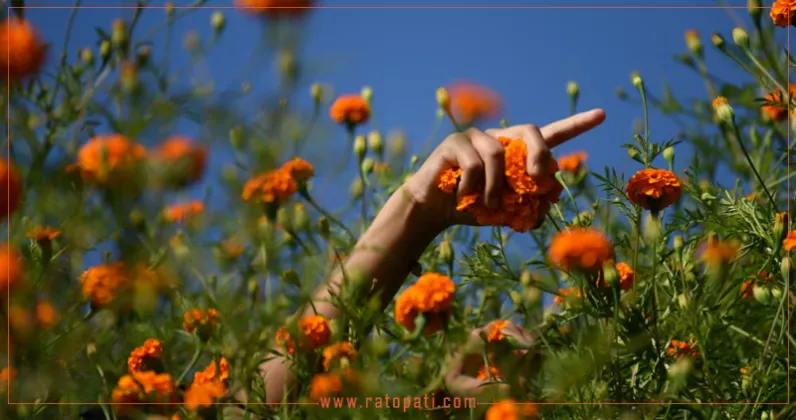
Marigold farmers in Nepal's eastern district of Jhapa are working against the clock this festival season. After their flowers bloomed earlier than usual, growers have started picking the blossoms ahead of schedule and storing them in cold stores to preserve their quality until Tihar. Along with the early harvest, farmers are weaving garlands in advance and rushing to complete every stage of their work, driven by the fear that a spell of rain could damage a crop that provides their main festival-season income. According to reports by RatoPati, Khabarhub and Nepal Press, the farmers' biggest concern now is keeping the flowers safe and fresh until the festival finally arrives.
Early Bloom Upsets the Tihar Calendar
Marigold, known locally as sayapatri, is the signature flower of Tihar, the festival of lights when garlands of orange and yellow blossoms decorate homes, shops, offices and temples across the country. For commercial growers, the festival is the peak of the year: demand for garlands and loose flowers rises sharply in the days before Tihar, and with it the prices farmers can command.
To hit that window, farmers traditionally time their cultivation so the crop flowers only shortly before the festival. This year, however, marigold fields across Jhapa flowered earlier than usual, leaving growers with fully bloomed flowers while Tihar still lay ahead. The result is a timing problem the farmers did not plan for and cannot simply wait out.
The difficulty is heightened by the nature of the flower itself. Marigolds are delicate and highly perishable, and a bloom that opens too soon begins to lose the freshness and appearance that buyers look for. A flower left standing in the field, meanwhile, remains exposed to sun, wind and rain. Once a blossom passes its best, its market value falls quickly, which is why the early flowering has set off a hurry across the district's flower-growing areas.
Jhapa, a Terai district in Koshi Province with a strong commercial farming base, relies on crops such as marigold for part of its festive-season agricultural economy, making the fate of this year's early bloom a matter of real consequence for local households.
Cold Storage Becomes the Safety Net
To bridge the gap between an early harvest and a festival that has yet to arrive, Jhapa's farmers have turned to cold storage. Picked flowers are being placed in cold stores, where lower temperatures slow the wilting process and help the petals retain their colour and shape until they can be sold.
The storage drive is being paired with advance preparation of the product itself. Farmers have begun weaving garlands ahead of the festival, stringing the early blooms into the wreaths that households and businesses will hang during Tihar. By storing finished garlands alongside loose flowers, growers hope to have saleable stock ready the moment demand appears.
In practice, the response to the early bloom now involves several steps being carried out at once:
- Harvesting flowers as soon as they are ready, rather than leaving them in the field
- Moving the picked blossoms into cold stores to preserve their quality
- Weaving garlands in advance and keeping them fresh for the festival
- Monitoring the weather, since rain remains the biggest threat to both standing and stored flowers
Racing the Rain to Save the Harvest
The urgency is not only about the calendar. Farmers say they fear that rain could damage the flowers, and that concern has pushed them to speed up harvesting and storage across the district. Rain at this stage can batter petals, encourage rot and strip a marigold of the visual appeal that decides its price, so every period of wet weather raises the risk to a crop that is already out of step with the festival.
That fear has compressed work that would normally be spread over a longer period. Picking, sorting, storing and garland-making are all being done faster than usual, as growers try to bring their flowers under cover before the weather can take a toll. The usual rhythm of the Tihar season in Jhapa has, by the farmers' own account, given way to a race to protect the harvest.
Anxious Growers Wait for Festival Demand
For the farmers of Jhapa, the stakes are considerable. The days around Tihar are the most important selling period of the year for marigold growers, and the income earned in that short window supports families across the district. That is why, even with the flowers picked and placed in storage, many say they remain worried about whether the blossoms can be kept safe until the festival.
Their concerns are practical ones: whether the cold stores will hold the flowers' freshness, whether the garlands woven now will still look bright when buyers arrive, and whether rain will spare both the fields and the stored crop. If the flowers lose their quality before the festival, the season's effort could go to waste.
Until Tihar arrives, the farmers can do little more than continue the round of picking, storing and stringing, and hope that the flowers that bloomed too soon will still be at their best when the festival lights up homes and temples across the country.


