
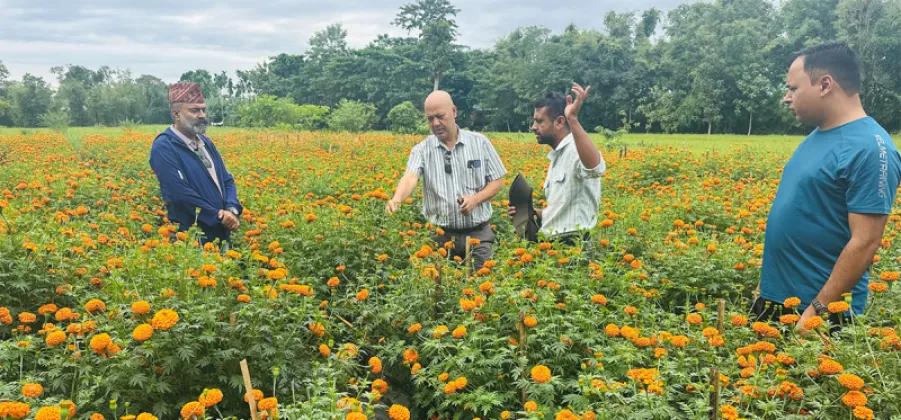
Three farmers of Budhashanti Rural Municipality-3, Duiringe, in Jhapa district, have turned their paddy fields into commercial marigold farms, moving away from a crop that earned them only about Rs 50,000 a year toward one they hope will fetch Rs 1 million to Rs 1.2 million in flower sales this season. The group has invested around Rs 500,000 in the new venture, according to reports published by Nagarik News, RatoPati and Pradesh Khabar.
From Paddy to Petals: The New Farm Arithmetic
The economics behind the switch are stark. On the same plots that produced roughly Rs 50,000 worth of paddy per year, the farmers are now targeting flower sales of Rs 1 million to Rs 1.2 million. The key figures from the reports are as follows:
- Previous annual income from paddy: about Rs 50,000
- Investment in marigold farming: around Rs 500,000
- Targeted income from flower sales: Rs 1 million to Rs 1.2 million
At the lower end of the projection, the marigold crop would generate roughly 20 times the income the land yielded under rice; at the upper end, about 24 times. Put another way, a single flowering cycle is expected to earn the farmers what paddy would have delivered over two decades on that plot.
The capital committed is equally significant. The Rs 500,000 investment equals about ten years of the land's previous paddy income, meaning the farmers have staked substantial resources on the belief that flowers will outperform grain. If sales reach the projected range, the venture would more than recover the initial outlay. The shift is particularly striking in Jhapa, one of Nepal's leading paddy-producing districts in the eastern plains, where rice cultivation has long dominated both the landscape and the livelihoods of farming families.
Why Marigolds Command a Premium
Marigold, known locally as sayapatri, holds a central place in Nepal's cultural and agricultural economy. Strings of orange and yellow blooms adorn doorways, vehicles, shops and deities during Tihar, while demand also rises around Dashain, weddings, welcome ceremonies and temple offerings. For garland sellers and event decorators, a steady supply of fresh flowers during the festival season is essential, and that is precisely the market commercial growers aim to serve.
Because demand is concentrated in a narrow window around the festivals, timing is everything in marigold farming. Growers plan their planting so the crop comes into flower just as the market peaks, allowing them to fetch the strongest prices of the year. This seasonal premium is what gives flower farming its edge over staple cereals, which sell at relatively stable but modest rates throughout the year. For the Duiringe farmers, the crop therefore offers something paddy could not: the prospect of a high-value harvest from the same land, provided the flowers reach the market at the right moment.
A Signal for Crop Diversification
The Budhashanti venture arrives amid a broader conversation about the future of farming in Nepal's Terai. Paddy remains the backbone of the national food supply, but for many smallholders the returns have grown thin, prompting farmers in various districts to explore higher-value alternatives such as vegetables, herbs and cut flowers.
If the Duiringe farmers achieve their target, their experience could offer a template for others weighing similar decisions. The case demonstrates that the constraint on farm income is not the land itself but what is planted on it: soil that produced Rs 50,000 worth of paddy in a year is now expected to yield more than Rs 1 million in flowers. It also underscores the growing role of commercial floriculture in an agricultural economy traditionally centered on food grains.
Risks Between Bloom and Market
Commercial flower farming is not without hazards. The crop must survive weather shocks, pests and disease, flowering must coincide with peak festival demand, and prices can fluctuate depending on overall supply in the market. Any delay or damage to the crop could erode the projected margins that make the venture attractive.
Whether the Rs 1.2 million target is achieved will become clear once the marigolds are harvested and sold. For now, the three farmers of Duiringe have placed their fields, and their Rs 500,000, on flowers rather than rice, and the coming sale season will show whether that calculation pays off at the scale they anticipate.
The original reports in Nepali are available at Nagarik News, RatoPati and Pradesh Khabar.


