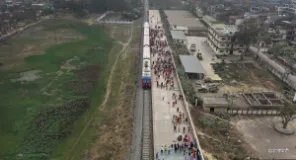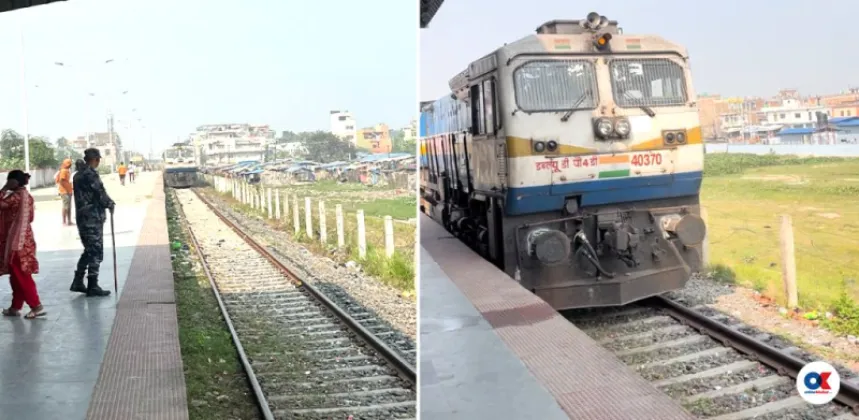
A special train operated from the Indian side completed a test run to Kurtha station in Janakpurdham on November 5, advancing preparations for a planned special rail service that will connect Nepal's Janakpurdham with Ayodhya in India. The trial train, running with two locomotives and seven coaches, travelled from Jayanagar across the border into Nepal's Dhanusha district. Local officials described the exercise as part of ongoing preparations for the service, which is expected to boost tourism and trade between the two neighbouring countries.
Trial run from Jayanagar to Kurtha
The test was carried out using an Indian special train hauled by two WDP 4D 40403 locomotives, with seven coaches attached. The train began its journey at Jayanagar on the Indian side of the border and travelled to Kurtha station, located in Janakpurdham, the headquarters of Nepal's Dhanusha district.
Dhanusha Assistant Chief District Officer Bhudev Jha confirmed that the test run was conducted as part of preparations for the planned Janakpurdham-Ayodhya special train service. According to Jha, the exercise marks a step forward in the process of readying the route for the special service.
Test runs of this kind are generally conducted to check how a route and its rolling stock perform ahead of passenger operations. The November 5 run provided a practical demonstration of a full train formation travelling the same cross-border section that the special service is expected to use once it becomes operational.
Key details at a glance
- Service planned: Special train between Janakpurdham, Nepal, and Ayodhya, India
- Date of test run: November 5
- Train composition: Two WDP 4D 40403 locomotives and seven coaches
- Route tested: Jayanagar in India to Kurtha station in Janakpurdham
- Official statement: Dhanusha Assistant Chief District Officer Bhudev Jha said the test was carried out as part of preparations for the service
A corridor of faith between Janakpurdham and Ayodhya
Much of the optimism surrounding the project stems from the deep cultural and religious ties between the two endpoint cities. Janakpurdham, in the southern plains of Nepal, is revered by Hindus as the birthplace of Goddess Sita and is home to the historic Janaki Temple, one of the country's most visited pilgrimage sites. Ayodhya, in India, is revered as the birthplace of Lord Ram. The two cities figure prominently in the Ramayana tradition, and for generations devotees have travelled between them to honour the story of Ram and Sita.
A direct train connecting the two cities is therefore expected to serve a large pilgrim and tourist market. Easier travel between Janakpurdham and Ayodhya would allow devotees to visit the Janaki Temple and the holy sites of Ayodhya in a single journey, and businesses in both cities stand to gain from the increased flow of visitors. This potential is central to expectations that the route will give a significant push to tourism on both sides of the border.
Hopes for trade and cross-border connectivity
Beyond pilgrimage travel, the planned service is being watched for what it could mean for trade and broader connectivity. Nepal and India share a long open border and dense day-to-day movement of people and goods, and rail links such as the Jayanagar-Kurtha section are seen as a way to support that movement through organised transport corridors.
The route is expected to boost trade between the two countries, adding a commercial dimension to a service that is framed around special passenger operations. For Janakpurdham and the surrounding district, improved rail access toward the Indian network offers local traders, hotel operators and transport businesses the prospect of new customers and smoother movement of goods.
Kurtha station, which received the test train on November 5, serves as the Nepali point on this section, and its role is likely to grow if the special service becomes a regular feature of travel between the two countries.
Preparations move forward
The November 5 trial does not by itself mark the start of regular operations. Rather, it forms part of a preparation process that officials in Dhanusha say is under way for the Janakpurdham-Ayodhya special train service. The reports of the trial did not specify when the special service will formally begin, and further details on schedules and operations are expected to be announced as preparations progress.
For now, the movement of a twin-locomotive, seven-coach train from Jayanagar to Kurtha stands as the clearest indication yet that the rail link between Janakpurdham and Ayodhya is moving closer to reality, carrying with it the expectations of pilgrims, traders and tourism entrepreneurs on both sides of the border. As reported by Onlinekhabar and Rato Pati, the test run has raised hopes that the service will deliver lasting benefits in tourism and trade for both Nepal and India.