The Jairamghat-Halesi road in Khotang district, a 35-kilometre section of the Mid-Hill Highway, is finally set to undergo repair sixteen years after its blacktopped surface peeled away and left travellers with a badly deteriorated carriageway. A contract agreement worth Rs 7.21 million has been signed for the maintenance of the stretch, which runs from Jairamghat on the Dudhkoshi river to the religious site of Halesi. The signing of the agreement brings to an end a wait that has stretched over a decade and a half for the people who depend on the road for travel, trade and pilgrimage.
A surface that failed within years
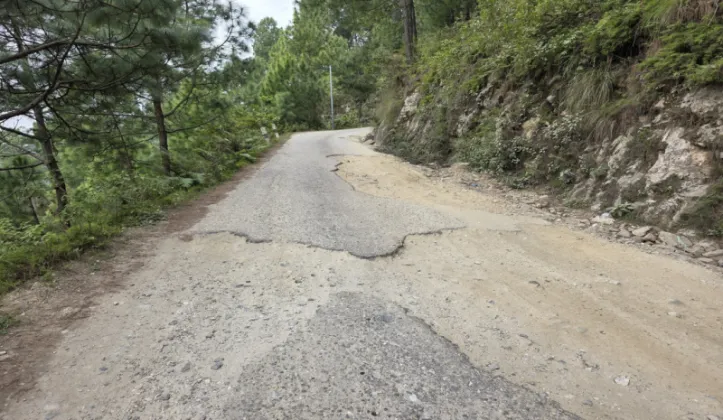
The road was blacktopped in 2067 BS, roughly 2010-2011, using the Otta Seal technique, a surfacing method chosen for the stretch at the time of construction. The surface, however, did not endure. Potholes began to appear within just a few years of the blacktop being laid, and over time the top layer peeled off almost entirely.
What followed was a long period of neglect. For sixteen years, the stretch was left without any substantial repair, and vehicles travelling between Jairamghat and Halesi had little choice but to negotiate a rough, pothole-marked road. The deterioration was particularly problematic because the route serves as a direct link to Halesi, which draws devotees and visitors, and because it forms part of a strategically important highway corridor through the hills of Khotang.
The new maintenance contract
Under the newly signed agreement, the maintenance work will cover the full 35-kilometre length of the road from Jairamghat, which lies on the banks of the Dudhkoshi, to the religious site of Halesi. The contract is valued at Rs 7.21 million, an investment intended to restore the stretch to a proper motorable condition after years of decay.
The repair holds significance beyond the immediate improvement in riding quality. The Jairamghat-Halesi road is part of the Mid-Hill Highway, one of Nepal's flagship road projects that threads through the hilly interior of the country. Keeping individual sections of such a corridor functional is essential for the continuity of the wider network, and the upkeep of this stretch is expected to contribute to that broader objective.
Key details of the repair at a glance:
- Road: Jairamghat-Halesi section of the Mid-Hill Highway
- Location: Khotang district, from Jairamghat on the Dudhkoshi river to the religious site of Halesi
- Length: 35 kilometres
- Contract value: Rs 7.21 million
- Original construction: Blacktopping carried out in 2067 BS using the Otta Seal technique
- Reason for repair: Potholes that emerged within a few years of construction, followed by sixteen years without major repair
Why the route matters
Halesi is a significant religious site, and the road from Jairamghat serves as the principal approach for pilgrims and other travellers heading there. For the communities living along the 35-kilometre corridor, the road is a daily lifeline, linking settlements in Khotang to the crossing point on the Dudhkoshi and to the wider road network beyond.
The condition of the road has a direct bearing on how easily people and goods move through this part of the district. A smooth surface reduces travel time and the wear and tear on vehicles, while a broken one does the opposite. The sixteen-year gap between the original blacktopping and the upcoming repair illustrates the cost of deferred maintenance on roads that carry both everyday local traffic and the movement of devotees.
The Mid-Hill Highway itself represents one of the country's most ambitious road undertakings, tracing a course through the middle hills and connecting districts that were historically difficult to access. Sections such as Jairamghat-Halesi form the building blocks of that network, which is why the state of any single stretch resonates well beyond the immediate area it serves.
Lessons from the Otta Seal experience
The failure of the original surface has become a cautionary episode in the district's infrastructure history. The Otta Seal technique was adopted in 2067 BS as the surfacing solution for the stretch, but it began to show distress within a few years, with potholes forming early and the blacktop eventually peeling away.
The experience underscores a broader point about road construction in Nepal's hilly terrain: surfacing choices and construction quality matter enormously, and timely maintenance is just as important as the initial build. A road that is not repaired promptly after the first signs of deterioration can slip into far worse condition, requiring more extensive intervention later, as the sixteen-year wait on the Jairamghat-Halesi stretch demonstrates.
With the contract now in place, attention will turn to execution. Travellers and residents along the route will be watching to see whether the maintenance work delivers a durable surface this time and whether it is completed without further delay. For a road that has waited sixteen years for attention, the expectation is that the newly funded repair will finally provide the reliable link that the original blacktopping promised but did not sustain.
The agreement and the history of the road's deterioration were reported by Gorkhapatra Online and Khabarhub.