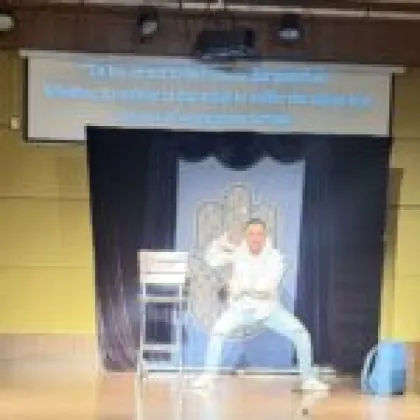
Kathmandu this week played host to an intimate piece of international theatre as the Israeli solo play 'Without an Evil Eye' was staged in the capital, presented by Israel's Nefesh Theatre with facilitation from the Embassy of Israel in Nepal. Running for roughly one hour, the production draws on the real-life experiences of Israeli artist and writer Asaf Bel Shimon, telling the story of his struggle with progressive vision loss and the journey he made toward seeing life with a new, positive outlook. Students of Pragya Kunja, along with invited guests, watched the performance and saw a single life story unfold before them on stage.
A story drawn from real life
Few forms of theatre are as demanding, or as personal, as the solo play. With no ensemble to share the stage and no secondary characters to carry the narrative, a single performer must hold an audience for the full length of the show. 'Without an Evil Eye' embraces that challenge, condensing one man's lived experience into a tightly paced one-hour production.
At the heart of the play is a deeply personal transformation. Bel Shimon's story traces his experience of progressive vision loss, a condition that gradually alters the way he navigates the world. Rather than treating the loss of sight as an ending, the production follows the Israeli artist and writer as he learns to see life differently, arriving at a renewed and positive outlook that reshapes his relationship with everything around him.
In essence, the play moves through three broad phases:
- the experience of gradually losing one's eyesight, and the uncertainty it brings
- the emotional and practical struggle that accompanies such a change
- the discovery of a fresh, positive way of viewing life despite the loss
The title resonates closely with this journey. To look upon the world 'without an evil eye' is to look without bitterness, and the production mirrors that sensibility, charting a path from hardship toward acceptance and hope rather than despair.
From personal experience to the stage
Solo theatre built on autobiography carries a particular weight. What the audience receives is not a fictional character but the shape of a real life, told through a production that has chosen that story as worth sharing. In bringing Bel Shimon's experiences to the stage, Nefesh Theatre placed a personal account of disability and adaptation at the centre of an evening's performance, trusting that an honest story, plainly told, could hold a room.
Nefesh Theatre brings the production to Kathmandu
The Kathmandu staging was presented by Nefesh Theatre and made possible with facilitation from the Embassy of Israel in Nepal. The embassy's involvement placed the performance within the wider frame of cultural exchange between the two countries, using the stage rather than formal diplomacy to introduce Israeli storytelling to a Nepali audience.
Solo theatre of this kind also travels well. With a compact running time of about an hour and a single narrative voice at its centre, the production can be staged for different audiences in different settings, which makes it a practical vehicle for international cultural programming. For Kathmandu audiences, it offered the chance to experience contemporary Israeli theatre live, as reported by News of Nepal.
A compact format with a wide reach
The one-hour length also shaped who could watch it. A brisk, self-contained performance fits comfortably into a school audience's schedule, allowing students to experience a complete work of theatre without the demands of a full-length production. That accessibility suited the gathering in Kathmandu, where young spectators watched alongside invited guests.
Students take in a story of resilience
Among those in the audience were students of Pragya Kunja, joined by invited guests. For young spectators, the staging doubled as an encounter with a form of storytelling that no textbook can replicate: a real person's account of adversity, performed live and resolved not in tragedy but in a changed perspective.
Plays drawn from lived experiences of disability carry particular weight in such settings. By dramatizing vision loss rather than merely describing it, 'Without an Evil Eye' invites its audience to consider how a person adapts when circumstances change, and how outlook itself can become a form of resilience. For students still forming their own view of the world, the play's central message, that the way one sees life can change even when circumstances cannot, lands with rare directness.
The Kathmandu performance therefore served several purposes at once. It brought an Israeli production to a Nepali stage, it gathered school students and guests around a shared cultural experience, and it carried Bel Shimon's story beyond his own country. For an hour, a single narrative bridged the distance between Israel and Nepal, leaving the audience with a story about sight, and about how one learns, in the fullest sense, to see.