
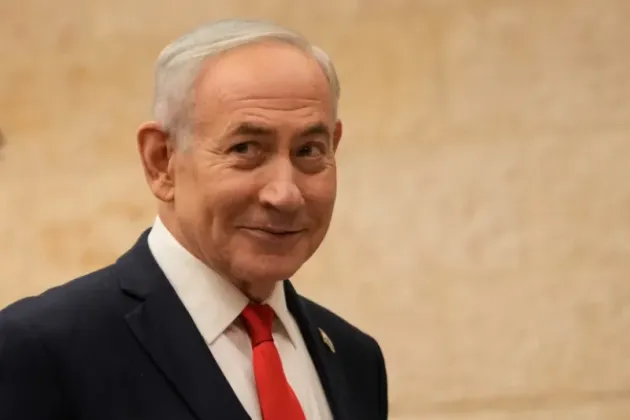
Israel’s parliamentary election has left Prime Minister Benjamin Netanyahu’s right-wing and ultra-Orthodox bloc short of a majority, with about 90 percent of votes counted, as coalition talks remain uncertain. The bloc holds 53 seats in the 120-member Knesset, against 48 for the opposition led by former military chief Gadi Eisenkot and 19 for Arab-led parties. A governing majority requires 61 seats. The result follows Israel’s first election since the Hamas attack of October 7, 2023, and the subsequent war in Gaza. The new Knesset is due to be sworn in on November 10.
Results leave the balance of power unsettled
The preliminary seat count gives no bloc a clear path to govern on its own. Netanyahu’s coalition is eight seats short of the 61 needed for a majority, while the opposition grouping has 48 seats and would also need support from outside its bloc. The Arab-led parties’ 19 seats therefore matter to the parliamentary arithmetic, although their potential role in a government has not been settled.
If all 19 Arab-led lawmakers were to align with the opposition, the combined tally would reach 67 seats. That figure is an arithmetic possibility, not an announced coalition agreement. The parties have signalled cooperation with the opposition, but the available results and statements do not establish that they have agreed to join a government or provide it with formal support. With counting still underway, the seat distribution remains preliminary.
The election followed a period defined by the October 7 attack and the Gaza war. It was the first national parliamentary vote since those events, placing the results against a backdrop of conflict and political uncertainty. A report on the election also put voter turnout at 72.97 percent, describing it as a record high in decades. The turnout figure adds another measure of the public participation surrounding a vote whose final political outcome will depend on negotiations as well as the count.
Vote-theft claims draw competing accusations
Netanyahu’s Likud party alleged that Arab parties had stolen votes and called for an investigation by the police and Shin Bet, Israel’s domestic security service. The demand has added a dispute over the integrity of the vote to the uncertainty over who can assemble a governing majority. The allegation is the party’s claim; it is not established as fact by the preliminary result.
Opposition and Arab-led parties accused Netanyahu of trying to discredit the election outcome. Their criticism reflects a direct clash over how the claims should be understood, while the announced seat totals leave the parliamentary balance unresolved. The available information does not establish the outcome of any requested investigation or provide a final finding on the allegations.
Coalition negotiations face a narrow path
The numbers leave several political questions open. Netanyahu’s bloc would need additional support to reach 61 seats, while the opposition would also need partners beyond its 48 seats. Arab-led parties have indicated willingness to cooperate with the opposition, but the extent and terms of that cooperation remain uncertain. The preliminary tally alone does not show whether either side can secure the support required to govern.
The next formal step is the swearing-in of the new Knesset on November 10. Until then, the seat count and the parties’ positions provide the basis for negotiations, but do not determine who will form the next government. For now, Netanyahu’s bloc has fallen short of a majority, the opposition has not reached one either, and the 19 seats held by Arab-led parties sit at the centre of the coalition arithmetic.


