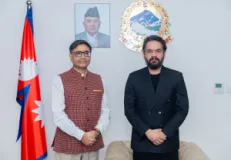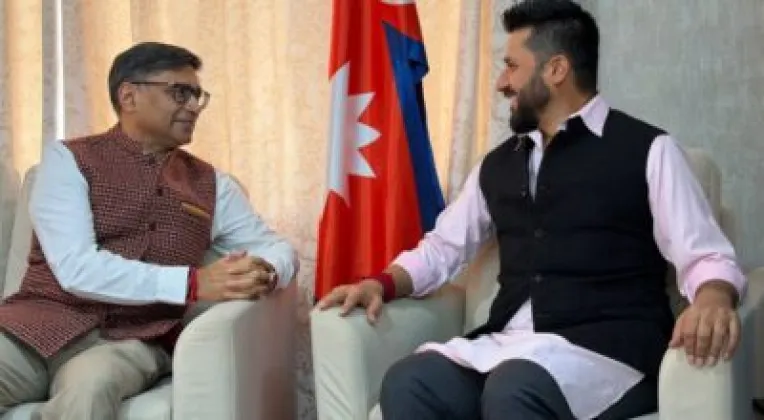
Indian Foreign Secretary Vikram Misri met Rastriya Swatantra Party (RSP) Chair Rabi Lamichhane at Lamichhane's residence in Budhanilkantha, Kathmandu, on Thursday, as part of a two-day official visit to Nepal by New Delhi's top diplomat. The meeting was confirmed by the RSP secretariat and reported by Khabarhub, RatoPati and Thaha Khabar, which tracked the senior Indian official's engagements in the Nepali capital.
A Diplomatic Call at the RSP Chair's Residence
The meeting took place at the private residence of the RSP chair in Budhanilkantha, an area on the northern edge of the Kathmandu Valley. Rather than a formal venue such as a party office or a government guesthouse, the call was hosted at Lamichhane's home, giving the encounter the character of a courtesy visit between two figures well acquainted with the demands of public office.
Misri, the senior-most official in India's Ministry of External Affairs, sat down with Lamichhane, who leads one of the most closely watched parties in contemporary Nepali politics. The RSP secretariat publicised the meeting through its own communication, providing the primary public account of what was discussed. Nepali news outlets covering Misri's visit carried the party's account of the exchange, underscoring the interest generated in Kathmandu by the presence of India's foreign secretary during his short stay.
Lamichhane Recalls India Visit, Underlines Economic Diplomacy
According to the RSP secretariat, Lamichhane recalled his earlier official visit to India during the conversation with Misri. By invoking that trip, the RSP chair connected his own direct experience of engagement with India to the present moment in bilateral relations.
Lamichhane also told the visiting foreign secretary that Nepal is focusing on development and economic diplomacy. The framing placed the emphasis of the conversation squarely on forward-looking priorities, positioning the India-Nepal relationship around growth, prosperity and practical cooperation rather than ritual exchange alone.
The emphasis on economic diplomacy echoes a recurring theme in Nepal's dealings with its neighbours and development partners. India occupies a central place in Nepal's external relations, and the regularity of high-level contacts between the two capitals reflects the breadth of the agenda that binds them, from trade and investment to connectivity and energy.
Part of a Two-Day Official Visit
The call on Lamichhane formed part of Misri's two-day official visit to Nepal. Visits of this kind by India's foreign secretary generally combine engagements with the government in power with interactions across the wider political spectrum, and the meeting with the RSP chair fits that established pattern of outreach to leaders beyond the government benches.
While the reports available did not detail the full itinerary of the trip, the Budhanilkantha meeting demonstrated that the Indian envoy's schedule extended beyond strictly government-to-government business. Engaging with party leaders is a long-standing feature of senior diplomatic visits to Kathmandu, reflecting the multi-party character of Nepal's democracy and the recognition that relationships between the two countries run deeper than any single administration.
The Broader Backdrop of India-Nepal Ties
India and Nepal share a relationship anchored in geography, history and culture, sustained by an open border and dense people-to-people ties. Cooperation between the two countries spans a wide range of areas, including:
- Trade and transit
- Cross-border connectivity and infrastructure
- Energy and hydropower cooperation
- Cultural exchange and people-to-people contact
Against that backdrop, a meeting between a visiting Indian foreign secretary and the chair of a major Nepali party carries significance beyond its immediate content. It signals continuity in political-level contact at a time when both sides regularly describe their relationship as one built on shared interests and mutual benefit.
What the Meeting Signals
For Lamichhane and the RSP, the visit provided an opportunity to articulate the party's reading of Nepal's foreign policy priorities directly to a senior Indian official. The secretariat's account of the meeting, highlighting Lamichhane's reference to his earlier India trip and his stress on development and economic diplomacy, presented the RSP chair as engaged with the conduct of Nepal's external relations.
For Misri, the call on the RSP chair formed one component of a two-day visit in which India's top diplomat engaged with interlocutors in Kathmandu. Details of the discussion beyond the RSP secretariat's statement were not immediately available, and the Indian side did not release a detailed readout in the reports published so far.
Nevertheless, the meeting itself conveyed a clear message about the state of India-Nepal engagement. High-level exchanges continue to bring together figures from across Nepal's political landscape, and the Budhanilkantha meeting on Thursday added a visible political dimension to Misri's two-day official visit, reinforcing the pattern of regular, multi-layered contact that continues to define relations between Kathmandu and New Delhi.