
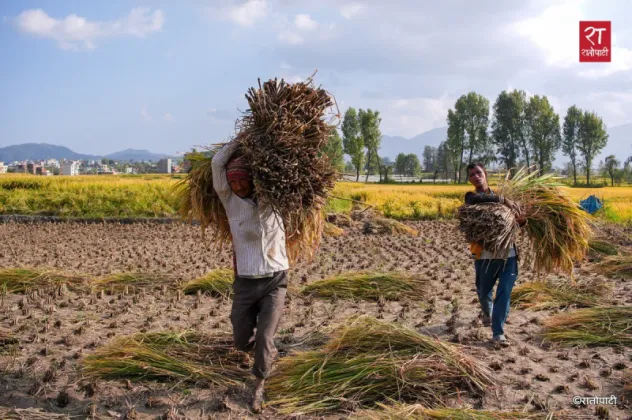
Farmers in Hetauda have been compelled to bring in agricultural labourers from Terai districts such as Sarlahi, Bara and Parsa to plant and harvest their paddy, as a growing shortage of local farm workers leaves fields without enough hands at the busiest time of the agricultural calendar. The dependence on outside labour is now visible across several localities of the Makawanpur district headquarters, where the seasonal rhythm of paddy cultivation is increasingly being sustained by workers who travel up from the plains. According to a report by Ratopati, the situation reflects a deepening manpower crunch in the local farm sector.
Terai Labourers Keep the Paddy Work Moving
In areas including Kamane, Chaughada, Chuchchekhola and Hatiya, labourers from the Terai have been at work in the paddy fields, helping farmers complete planting on schedule and bring in the harvest. These workers, drawn from Sarlahi, Bara and Parsa, have effectively become the backbone of Hetauda's paddy operations at a time when local hands are hard to find. The localities where their presence has been most noted include:
- Kamane
- Chaughada
- Chuchchekhola
- Hatiya
Paddy cultivation is among the most labour-intensive forms of farming. Transplanting seedlings and harvesting ripe grain both demand a large workforce within a short window of time, and any delay during these critical stages can put the season's output at risk. That timing pressure is precisely why the shortage of local workers is being felt so keenly by farmers in and around Hetauda, who cannot simply wait for labour to become available once the crop is ready.
A Familiar Scene With New Faces
The sight of Terai workers in Hetauda's fields reflects how the traditional model, in which farming families and their neighbours managed the season's work together, has given way to hired labour brought in from outside. For generations, paddy planting and harvesting in Nepal's hills and inner valleys were largely community affairs, with exchange labour and family hands doing much of the heavy work. The current dependence on workers from Sarlahi, Bara and Parsa shows how thoroughly that arrangement has changed in Hetauda, where the fields are now tended largely by people who travel from far-off districts for the season.
Why Local Hands Are Scarce
The labour shortage driving this reliance on outside workers is attributed to two interconnected trends, both of which have been reshaping rural Nepal for years:
- Declining interest in farming among local youth, who increasingly see agriculture as hard, uncertain work and look for other livelihoods
- Out-migration for foreign employment, as young people leave for jobs abroad in search of better incomes
As younger residents of Hetauda and its surrounding areas pursue education, urban employment and opportunities overseas, fewer of them remain available or willing to take up seasonal farm work. Foreign employment in particular has drawn a large share of the working-age population away, leaving ageing family members to manage holdings that still require intensive manual labour at planting and harvest time. The result is a gap that local farmers can no longer fill on their own.
Local resident Shri Prasad Neupane was among those quoted in the Ratopati report describing the situation, pointing to the growing reliance on workers from outside as a sign of how thin the local agricultural workforce has become. His account captures the experience of many farming households in the area, which now plan their paddy season around the availability of Terai labourers rather than the help of neighbours.
What the Shortage Means for Farmers
For farmers, arranging workers from distant districts adds a layer of coordination and expense to an already demanding season. Transport, wages and the logistics of hosting outside crews must all be managed on top of the farm work itself, even as the planting and harvesting still have to be completed on time. While the arrival of Terai labourers has kept Hetauda's paddy operations running, it also means that local agriculture is increasingly dependent on the willingness of workers from the plains to make the trip each season.
The situation in Hetauda also underscores a wider question facing Nepal's farm sector: as domestic and foreign migration continue to pull young people away from villages, who will do the field work that remains? Paddy remains central to the country's food supply, and the labour that produces it has to come from somewhere. In Hetauda, that somewhere, for now, is Sarlahi, Bara, Parsa and other Terai districts.
For the present season, farmers in Kamane, Chaughada, Chuchchekhola and Hatiya are managing to get their paddy planted and harvested thanks to the Terai workforce. But as the Ratopati report makes clear, the underlying shortage of local agricultural labour persists, and the growing dependence on outside workers has become a defining feature of paddy farming in the area.


