
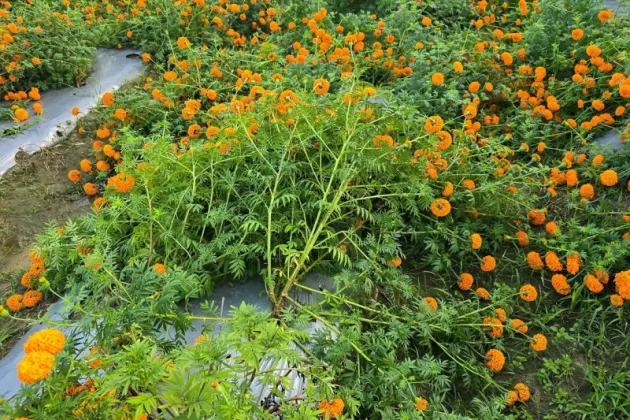
Farmers in Bhimad Municipality of Tanahun district are increasingly turning to marigold farming, and the shift is already showing results: locally grown flowers are beginning to replace the blooms traditionally imported from outside during the festive season. The cultivation is concentrated in various locations of wards 5 and 6 of the municipality, with farmers timing their production for the Tihar festival, when demand for marigolds peaks across Nepal. Yet even as the trade blossoms, growers are united by a pressing worry, the absence of storage facilities that could keep their harvested flowers fresh for a long time, a gap that threatens to cut into the returns from an otherwise promising seasonal crop.
Sayapatri takes root in Bhimad
The marigold, known in Nepali as sayapatri, holds a special place in the country's festival calendar. Its bright orange and yellow garlands are woven into nearly every ritual of Tihar, from the worship of the goddess Laxmi to the decoration of homes, shops and public spaces. It is precisely this dependable festive demand that has drawn a growing number of farmers in Bhimad Municipality toward the flower, according to a report by RatoPati.
The farming activity is spread across several locations within wards 5 and 6 of the municipality, making the area a small but notable hub of flower production in Tanahun district. Farmers plan their cultivation cycle around the Tihar season, working to ensure that the flowers are ready for harvest just as households and traders begin searching for garlands. The rising attraction to the trade reflects how a seasonal flower crop is steadily becoming a source of cash income for local farming families, even without dedicated large-scale infrastructure.
Local blooms replacing festive imports
For years, the surge in demand during Tihar has been met largely by flowers brought in from outside, forcing local markets to depend on supplies arriving from elsewhere while money flowed out of the community. What makes the developments in Bhimad significant is that local production is beginning to replace those imported flowers during the festive season. Blooms that once would have travelled in from distant markets are now being sourced from fields within the municipality itself.
The benefits of this substitution work in two directions. For consumers, locally grown marigolds offer fresher flowers that have spent less time in transit, which matters enormously for a product whose beauty fades within days. For farmers, every garland sold from a local field means income that remains within the local economy rather than being sent to outside suppliers. In a district where agriculture remains the backbone of many households, the rise of festive flower farming points to a simple but effective form of import substitution, one grown from the initiative of individual farmers rather than any large programme.
Storage shortage clouds the harvest
Despite the encouraging growth, farmers in Bhimad are not celebrating without reservation. Their chief concern is the lack of storage facilities to keep harvested marigolds fresh for an extended period. Marigolds are among the most perishable of festive commodities; a garland that looks vibrant in the morning can begin to wilt within a couple of days. Without a way to preserve their harvest, farmers have little choice but to sell their flowers almost immediately after picking them, whatever the prevailing price may be.
That immediate-sale compulsion carries real costs. When many farmers in wards 5 and 6 bring their flowers to market at the same time, the sudden abundance can push prices down, leaving growers with thin returns despite a successful harvest. Conversely, in the days of peak festive demand, when prices would normally be strongest, farmers without storage are unable to hold back stock to take advantage. The inability to keep flowers fresh for long effectively robs growers of control over the timing of their sales, which is often where the profit in perishable crops lies.
With proper storage, farmers would be able to:
- hold their harvest until the highest-demand days of the festival, when prices are most favourable
- spread out sales over the festive week instead of being forced into a single selling window
- reduce wastage by protecting flowers from wilting before they reach buyers
A blooming opportunity held back by a bottleneck
The story of marigold farming in Bhimad captures both the promise and the fragility of smallholder agriculture in Nepal's hill districts. On one hand, the growing attraction to the crop shows how farmers respond quickly to market signals, turning the festive calendar into a source of income and, in the process, reducing dependence on flowers from outside. On the other hand, the storage shortage shows how a single missing piece of post-harvest infrastructure can limit what farmers are able to earn from their own success.
If the storage gap were addressed, the farmers of Bhimad Municipality would be far better placed to capture the full value of the festive-season market, strengthening what has already begun as a genuine local replacement for imported flowers. Until then, growers remain caught between a market that is blooming and a bottleneck that threatens to trim their harvest of its worth, hoping that the flowers they have worked all season to grow will reach customers while they are still fresh.


