
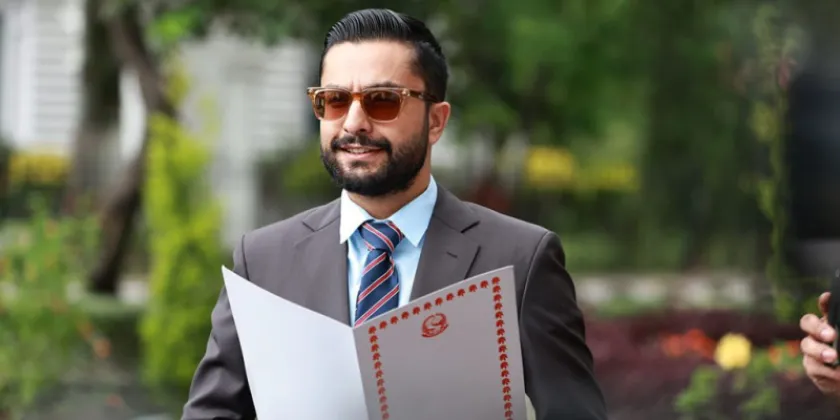
KATHMANDU: Government spokesperson and Education Minister Sasmit Pokharel said on Tuesday that the arrests of journalists were carried out by the police and were not authorised by the government. Speaking at a press briefing in Kathmandu held to announce the cabinet's decisions, Pokharel maintained that the government has no policy of detaining journalists, and said the police had acted only to inquire how certain published news reports were produced. He described the episode as an internal matter between the government and the police, and insisted that the journalists involved had merely been questioned rather than detained.
Pokharel distances the government from police action
Pokharel, who serves as the government's official spokesperson in addition to his role as education minister, took up the issue while briefing reporters on the decisions taken by the cabinet. According to his account, the decision to arrest the journalists did not originate from the political leadership.
The arrests, he said, were a police undertaking, and the government had played no part in ordering or approving them. In his telling, the police moved on their own initiative to ask questions about how news reports that had already been published were produced and brought out.
The spokesperson was categorical that detaining journalists forms no part of his government's policy. At the same time, he sought to minimise the severity of what took place, saying that the journalists were only questioned and that the police action was limited to an inquiry into the published reports.
His remarks, reported by Nepal Press and Ratopati, came in response to questions over why journalists had been arrested in connection with published reporting.
The spokesperson's key claims
Summarising the position laid out by Pokharel on Tuesday:
- The arrests of the journalists were carried out by the police and were not authorised by the government.
- The government has no policy of detaining journalists.
- The police acted only to inquire how published news reports were produced.
- The journalists were only questioned, and the episode is an internal matter between the government and the police.
'Only a general interrogation was conducted'
A central element of Pokharel's defence was his characterisation of the police action as a limited, procedural step rather than a detention. When pressed on why a journalist had been arrested, the spokesperson's response, as reported, was to frame the incident as nothing more than a routine inquiry.
What the police conducted, he said, was a general interrogation. The questioning, in his account, was confined to the process behind the published reports, that is, how the news reports were produced. On that basis, he argued that the journalists had not been subjected to anything beyond questioning.
The formulation effectively asks the public to accept that an arrest followed by questioning does not amount to the detention of journalists, a distinction that places the emphasis on how the police action is labelled rather than on the fact that journalists were taken in at all.
'An internal matter between the government and the police'
Perhaps the most striking feature of the briefing was the framing Pokharel chose. Rather than presenting the arrests as a government decision gone wrong, or defending them outright, he described the episode as an internal matter between the government and the police, calling it an internal police issue.
That framing assigns the action squarely to the police while allowing the political leadership to maintain its distance. In the spokesperson's account, the question of how the arrests came about is one for the government and the police to address between themselves, not a matter of government policy toward the press.
His comments also leave the two halves of his own account in some tension. He acknowledged that arrests took place, attributed them to the police, and simultaneously maintained that the journalists were merely questioned about their published reports. How those two claims fit together was not explained in the remarks reported on Tuesday.
What the minister's account leaves open
Pokharel's statements raise as many questions as they answer. The reported remarks did not spell out on whose instructions the police acted, what legal basis was used to bring the journalists in, or what safeguard exists to prevent similar actions in the future. If, as the spokesperson said, the government gave no approval, the question of who within the police authorised the arrests and who will be held accountable remains unanswered.
Nor did the government's account explain why an inquiry into how published news reports were produced required arresting journalists rather than approaching them or their newsrooms through ordinary channels. The claim that the journalists were only questioned sits uneasily alongside the acknowledgment that arrests occurred, and the description of the episode as an internal police matter offers little clarity on which institution is answerable for the action.
For now, the government's public position, as laid out by Pokharel on Tuesday, rests on three points: it has no policy of detaining journalists, it did not authorise the arrests, and the matter sits with the police as an internal issue. Whether that is enough to settle the questions surrounding the arrests, and to reassure the journalists and media houses affected, remains to be seen.


