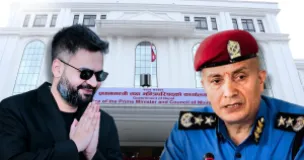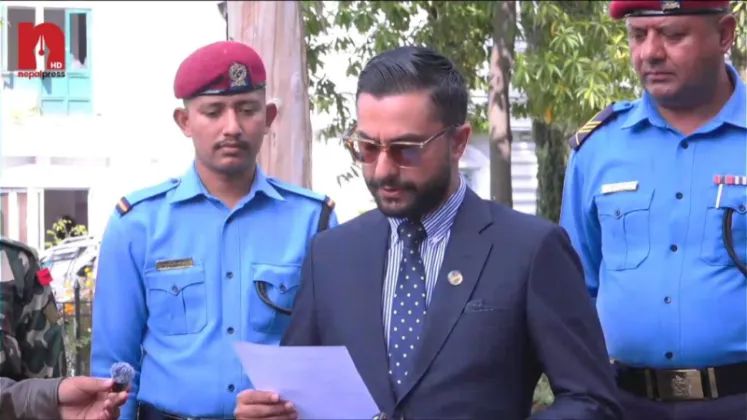
The government has made it clear that Inspector General of Nepal Police Dan Bahadur Karki has not been punished, saying the country's top police official has only had his responsibilities reassigned. The clarification came from government spokesperson and Minister for Education and Sports Sasmit Pokharel, who spoke to journalists after a Cabinet meeting in Kathmandu. Pokharel's remarks were made in response to questions about why the Inspector General was removed from his post, and he maintained that the decision should not be seen as disciplinary action.
"Responsibility has been shifted": the government's position
Speaking in his capacity as the government's official spokesperson, Pokharel drew a clear line between punishment and a change of duties. As reported by Nepal Press, the IGP is not being prosecuted and responsibility has been shifted instead. Nagarik News likewise quoted Pokharel as saying that the IGP was not taken into action and that his responsibilities were changed. Both reports convey the same core message: whatever decision the government has taken concerning Karki, it does not, in the government's reading, amount to a punitive measure.
The phrasing matters. "Responsibility has been shifted" and "responsibilities were changed" are formulations that place the decision in the category of administrative adjustment rather than sanction. Pokharel, who holds the Education and Sports portfolio alongside his duties as spokesperson, presented the move as a reassignment of responsibilities and nothing more. In his telling, the government has not taken any action against the officer; it has simply changed what he is responsible for.
A direct answer to questions over the removal
The spokesperson's comments came in direct response to questions from journalists about why the IGP was removed from his post. That line of questioning reflected the obvious public interest attached to a change at the very top of the Nepal Police, and the post-Cabinet briefing provided a clear public framing of the decision. Rather than allowing the removal to be characterised by others, Pokharel used the opportunity to set out how the government wants the move to be understood.
Government spokespersons in Nepal routinely brief the media after Cabinet meetings, and personnel decisions of this kind are among the items on which reporters seek clarification. In this case, the briefing became the venue for the government to present its characterisation of a sensitive change at the head of the police force, and Pokharel's language was pointedly directed at the question of whether the IGP had, in effect, been punished.
The central point of his answer was unambiguous: the removal from the post should not be interpreted as disciplinary action. By emphasising that Karki's responsibilities were changed rather than that he was punished, the spokesperson sought to move the discussion away from notions of fault, prosecution or sanction. In effect, the government is asking the public to see the decision as a matter of assigning duties, not as a step taken against the officer personally.
Why the distinction between punishment and reassignment matters
The distinction Pokharel drew carries real weight in how such decisions are read. The Inspector General of Police is the senior-most post in the Nepal Police, and any change involving its holder is scrutinised closely. Disciplinary action against a police chief would normally imply findings of fault and formal consequences attached to his conduct in office. Reassignment, by contrast, involves placing an officer's responsibilities elsewhere without, in the government's telling, any such implication.
That is the reading the spokesperson pressed: not prosecution, not action, but a shift of responsibility. At the same time, a change of responsibilities for an officer whose duties span the leadership of the entire police organisation is itself a consequential step, which helps explain why the government chose to characterise it explicitly. By stating plainly that the IGP has not been taken into action, Pokharel attempted to close off the interpretation that the removal was a punitive one.
The government's position at a glance
Taken together, the spokesperson's remarks can be summarised as follows:
- No punishment: The government says Inspector General Dan Bahadur Karki has not been punished or taken into action.
- Duties reassigned: According to the spokesperson, the IGP's responsibilities have been shifted, a change the government frames as administrative rather than punitive.
- No disciplinary action: Pokharel asked that the move not be seen as disciplinary action against the police chief.
- Setting: The statement was made to journalists after a Cabinet meeting in Kathmandu.
- Prompted by questions: The clarification was issued in response to questions about why the IGP was removed from his post.
For now, the government's official position stands as articulated by its spokesperson: the Inspector General has not been prosecuted or punished, his responsibilities have been changed, and the decision should not be read as disciplinary action. Pokharel's comments leave little ambiguity about how the government wishes the removal of the IGP from his post to be understood, and they represent the government's clearest public word on the matter so far.