
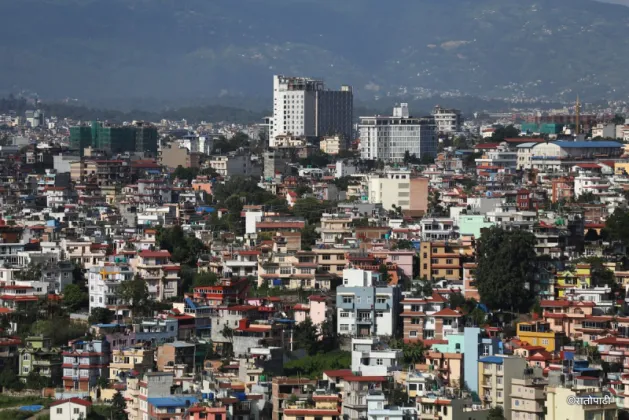
The Government of Nepal has formally taken ownership of 302 ropanis of land, approximately 15.36 hectares, spread across seven wards of Kathmandu Metropolitan City. The Land Administration Office, Dillibazar, removed the parcels from private ownership and registered them in the name of the state, in the course of implementing the fiscal year 1995/96 report of the Rawal Commission on government and public land. The action follows the findings of the High-Level Commission for Investigation and Conservation of Government and Public Land, the body whose work has brought the commission's recommendations into active implementation.
Land Registered in the Name of the State
According to a report published by Ratopati, the Land Administration Office based in Dillibazar carried out the registration, transferring 302 ropanis of land into the government's name. The parcels are spread over seven different wards of Kathmandu Metropolitan City, meaning the recovery touches a wide swath of the capital rather than a single location.
The core facts of the action can be summarized as follows:
- Total area: 302 ropanis, equivalent to 15.36 hectares.
- Spread: Land located in seven wards of Kathmandu Metropolitan City.
- Executing office: Land Administration Office, Dillibazar.
- Nature of the action: Removal of the land from private ownership and registration in the name of the Government of Nepal.
- Legal basis: The fiscal year 1995/96 report of the Rawal Commission on government and public land.
The removal of land from private ownership is a consequential administrative correction. It means that registry entries which had previously carried the parcels under private hands have now been amended so that the state stands as the recorded owner. Once such an entry is made, the land is held as government property in the official records maintained by the land administration office, and its earlier private registration no longer stands.
The area involved is considerable by any urban measure. A single ropani, the traditional unit of land measurement used in the Kathmandu Valley and across Nepal's hills, corresponds to roughly 508.7 square meters, or about 5,476 square feet. Around 20 ropanis make up a hectare, which is why the 302 ropanis at issue translate into 15.36 hectares of land in the heart of the capital.
The Rawal Commission Report Behind the Move
The foundation for the recovery lies in the report that the Rawal Commission prepared for fiscal year 1995/96. The commission was formed to look into the question of government and public land, and its report identified land that belonged to the state. Implementing a report of this kind involves revisiting land records, verifying the status of the parcels it flags, and correcting ownership entries where land identified as public has been found recorded under private ownership.
That implementation work is now proceeding under the framework of the High-Level Commission for Investigation and Conservation of Government and Public Land. It was this body's findings that set the stage for the present action, with the Land Administration Office, Dillibazar, translating those findings into a concrete change on the ground: land in seven wards of the capital is now formally registered to the Government of Nepal.
The sequencing of the process matters. A commission's findings, on their own, do not alter ownership; the change takes effect when the concerned land records offices act upon them. By striking the 302 ropanis from private ownership and re-registering them in the state's name, the Dillibazar office has moved the Rawal Commission's recommendations from the report page into the official land register.
Why the Recovery Carries Weight
The reclamation speaks directly to the mandate at the center of the High-Level Commission's work: the investigation and conservation of government and public land. Land registered in the name of the state is land that can be held for public purposes, kept out of private transactions, and protected from the ownership disputes that arise when public parcels appear in private registries.
Several dimensions of the move stand out:
- Restored state assets: 15.36 hectares of land in the capital have returned to the government's column of the land registry.
- Corrected records: The action addresses parcels that had been held under private ownership despite being covered by the Rawal Commission's findings on government and public land.
- Continuity of implementation: The recovery links the current land administration process to recommendations first set out in the fiscal year 1995/96 report.
The fact that the parcels lie across seven wards also gives the action citywide relevance for Kathmandu Metropolitan City. Rather than involving a single contested plot, the recovery covers land in multiple wards, underscoring the geographic scale at which the Rawal Commission's findings are being processed through the land administration system.
From Report to Registry
With the registration complete, the 302 ropanis now stand as recorded property of the Government of Nepal, marking a visible step in the implementation of the Rawal Commission's fiscal year 1995/96 report. The action by the Land Administration Office, Dillibazar, carried out in line with the findings of the High-Level Commission for Investigation and Conservation of Government and Public Land, represents a concrete outcome of that process: land that had been outside state hands in the capital has been brought back onto the government's books.


