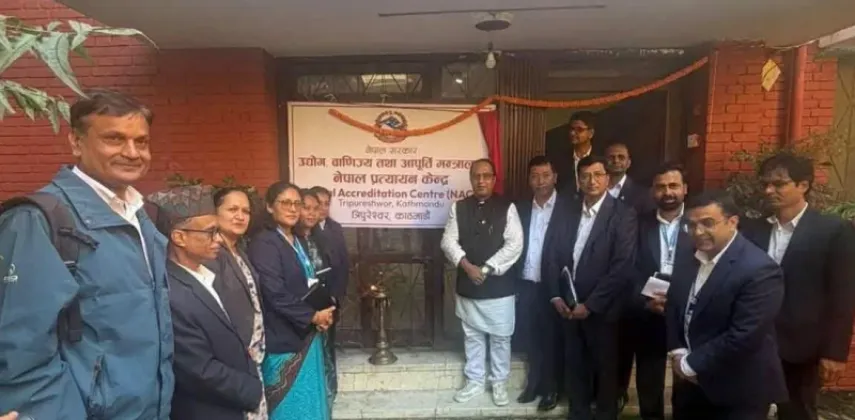
The federal government has opened the Nepal Accreditation Centre at Tripureshwor, Kathmandu, in a move it says will strengthen the country's quality infrastructure, support industrial development and facilitate trade. Minister for Industry, Commerce and Supplies Dipak Kumar Sah inaugurated the centre on Wednesday. Speaking at the launch, the minister said the new institution would help reduce costs for industry, boost consumer confidence and connect Nepali products to the global market. The inauguration was reported by Rato Pati, Nagarik News and Khabarhub.
A new pillar of quality infrastructure
The establishment of the Nepal Accreditation Centre gives Nepal a dedicated national institution for accreditation, the formal recognition that testing and calibration laboratories, inspection bodies and certification bodies are competent to perform the work they do. When such conformity assessment bodies are accredited, the test reports, inspection findings and certificates they issue are accepted with far greater confidence by regulators, businesses and consumers alike.
According to the reports, the government established the centre with two clear objectives: supporting industrial development and facilitating trade. The choice of Tripureshwor places the new body in central Kathmandu, within easy reach of the government agencies and business communities whose work it is expected to support.
For manufacturers, importers and exporters, the practical value of such an institution lies in trust. A certificate or test report backed by accreditation carries an assurance of competence that an unaccredited document cannot offer, and that assurance sits at the heart of how modern quality systems function. By bringing an accreditation mechanism under a single national centre, the government is seeking to give Nepali industry a foundation on which credible, verifiable quality claims can be built.
Cutting costs and building consumer trust
At the inauguration, Minister Sah highlighted three headline benefits the centre is expected to deliver:
- Lower costs for industry, as producers gain access to recognised conformity assessment services at home rather than bearing the expense and delays of repeated verification elsewhere.
- Greater consumer confidence, as products carrying accredited certificates come with an independent assurance of quality and safety.
- Stronger links to the global market, as internationally accepted certificates and test reports help Nepali goods meet technical requirements in destination countries.
The cost argument is a familiar one in the world of quality infrastructure. Where recognised testing and certification are not readily available domestically, firms can find themselves paying repeatedly for the same checks, sending samples to foreign laboratories or waiting on external verification before goods can move. An accredited national system, in principle, allows those assessments to be completed locally and accepted more widely, trimming both expense and turnaround time for businesses of every size.
On the consumer side, the minister's point was that independent accreditation underpins trust in everyday transactions. When a product is certified by an accredited body, buyers have an external assurance that the underlying assessment was carried out competently and honestly, rather than resting solely on the word of the seller. Over time, that assurance can raise standards across the market and give honest producers an edge over those cutting corners.
Opening the door to the global market
The third plank of the government's case, trade facilitation, addresses a barrier Nepali exporters have long grappled with: the reluctance of foreign buyers and regulators to accept documents they cannot verify. In international trade, conformity documents issued by accredited bodies are far more readily recognised by foreign authorities, importers and certification schemes.
By building an accreditation system at home, the government hopes Nepali products can clear those technical hurdles with certificates and test reports issued in Nepal, rather than relying on overseas verification at every step. That matters most for export-oriented sectors, where a questioned report or an unrecognised certificate can hold up a consignment and erode hard-won buyer confidence. In Sah's framing, the centre is intended to serve as the bridge that carries Nepali products from the domestic factory floor to shelves and markets abroad.
From launch to operation
With the centre now inaugurated, attention will shift from announcement to operation. Details on the centre's staffing, working procedures and the pace at which it begins accrediting conformity assessment bodies were not set out in the initial reports.
What officials have made clear is the intent behind the institution. In the government's presentation, the Nepal Accreditation Centre is not merely a new office at Tripureshwor but an instrument of industrial policy, one it expects to lower the cost of doing business, reassure consumers at home and give Nepali products a credible passport into the global market. How effectively the centre delivers on those three promises will now be the measure by which the initiative is judged.