
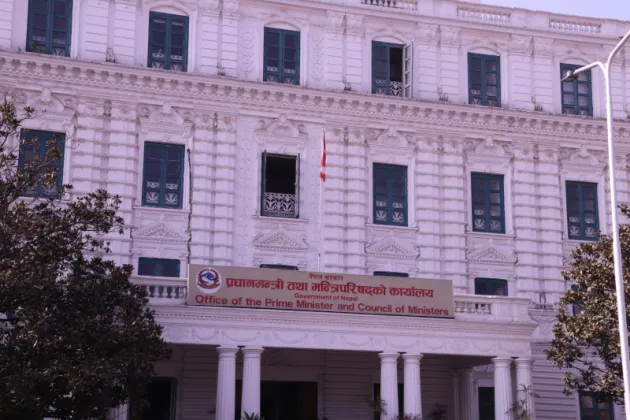
The government on Monday directed all ministries and government agencies to effectively implement the annual work plan as well as the policies and programmes announced for the current fiscal year 2083/84 (2026/27). The directive was issued at a meeting of secretaries held at Singha Durbar, the central seat of the federal administration in Kathmandu, and was chaired by Chief Secretary Gobinda Bahadur Karki, the senior-most civil servant of the country. According to Nagarik News, the meeting decided that a detailed implementation plan would be prepared and carried out within the timeframe set by the government, and that the Office of the Auditor General and other bodies would also be directed accordingly.
Secretaries' meeting at Singha Durbar
The Monday meeting brought together the government's top bureaucrats to review how the annual work plan and the policies and programmes for fiscal year 2083/84 are being put into practice. Khabarhub reported that the session, held under the chairmanship of Chief Secretary Karki, centred on making implementation more effective across the ministries and agencies of the federal government.
Singha Durbar, the historic complex that houses the Prime Minister's Office and key ministries, regularly hosts such coordination meetings of secretaries, the senior officials who head the ministries and central bodies of the bureaucracy. Chaired by the Chief Secretary, these gatherings serve as the main mechanism through which the administrative leadership aligns the day-to-day working of government bodies with the priorities set by the political leadership.
The decisions taken on Monday reflect that coordinating role. The meeting resolved to move the annual plan from paper to practice, tasking ministries with preparing a detailed implementation plan and completing their assigned work within the stipulated time.
Key decisions at a glance
As reported by Nepal Press, the main decisions of the secretaries' meeting were:
- To direct all ministries and agencies to effectively implement the annual work plan and the policies and programmes for the current fiscal year 2083/84
- To prepare a detailed implementation plan for those policies and programmes
- To carry out the plan within the timeframe set by the government
- To direct the Office of the Auditor General and other bodies accordingly
From announcement to delivery
The decision carries particular weight because, in Nepal's governance cycle, the annual policies and programmes announced at the start of each fiscal year define the government's priorities, while the budget provides the resources to pursue them. Ministries and subordinate agencies are then expected to convert those broad commitments into concrete activities, from service delivery and development projects to administrative reforms. It is at this stage, between announcement and execution, that the secretaries' meeting sought to intervene.
By asking each body to prepare a "detailed implementation plan," the meeting has effectively required the bureaucracy to break the annual work plan into specific tasks, assign responsibility for them and tie completion to fixed deadlines. The explicit reference to carrying out the plan "within the set timeframe" adds an element of time-bound accountability, which is intended to reduce the risk that priorities announced at the beginning of the year remain unimplemented.
The involvement of the Chief Secretary underscores the administrative seriousness of the directive. As the head of the civil service, the Chief Secretary chairs such meetings to ensure that the machinery of the state moves in step with the government's stated agenda, and that ministries and agencies do not treat the annual documents as routine formalities.
Oversight bodies brought within the directive
Notably, the meeting decided to direct the Office of the Auditor General and other bodies in the same manner as the ministries. The Office of the Auditor General is the constitutional body responsible for auditing the accounts of government offices, making it central to oversight of public spending across the federal structure.
Bringing the audit institution and other bodies under the same directive signals that the government views implementation of the annual plan as a whole-of-government exercise rather than a task for line ministries alone. With the directive in place, audit and oversight institutions, along with the various agencies attached to ministries, are expected to play their part as the work plan advances through the fiscal year.
What happens next
Responsibility now shifts to the ministries and agencies to draft and execute their detailed implementation plans within the government's timeframe. Fiscal year 2083/84 is already in progress, and the effectiveness of Monday's meeting will be measured by how quickly those plans are finalised and how faithfully the set deadlines are observed on the ground.
For now, the message from Singha Durbar is unambiguous: the policies and programmes adopted for the year are to be implemented, not merely announced, and every ministry, agency and oversight body has been told to play its part. Whether the directive translates into visible delivery will depend on the detailed plans now expected from each government body and on the monitoring that follows in the months ahead.


