
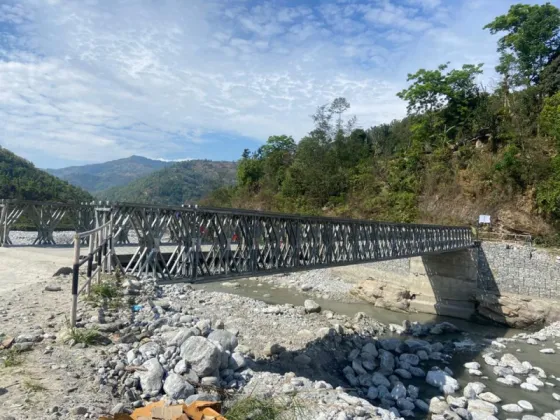
The Gandaki Province government is moving to build 15 Bailey bridges at once along rural roads in Baglung district, aiming to end the recurring disruption of vehicle movement caused by the absence of permanent crossings across the hill district. The process is being taken forward this fiscal year through the Infrastructure Development Office Baglung. The province has allocated 4 million rupees for each bridge, taking the total investment to 60 million rupees. Provincial Minister for Economic Affairs Jit Sherchan said the budget has already been allocated and that detailed project reports for the bridges are now being prepared, according to a report by Rato Patti.
The Monsoon Mobility Problem
In hill districts like Baglung, rural roads often remain incomplete without permanent bridges over the rivers and streams that swell during the monsoon. When the rains arrive, vehicles are forced to halt at unprotected crossings, cutting off villages from markets and service centres. It is precisely this problem that the Gandaki Province government's decision is designed to address, with the province pointing to the way the lack of permanent bridges disrupts vehicle movement on the district's rural roads during the rainy season.
The consequences of such disruption ripple through daily life. Passengers can be left stranded mid-route, farmers find it harder to move produce to bazaars, and students, patients and office-goers face long detours or cancelled journeys. For communities that depend on a single rural road for access to services, a missing bridge can effectively sever their connection to the wider district for an entire season.
By opting to install 15 Bailey bridges in a single coordinated programme rather than pursuing scattered, piecemeal construction, the province is seeking to close several of these gaps at the same time.
Why Bailey Bridges
A Bailey bridge is a prefabricated steel truss bridge whose modular components can be transported to remote sites and assembled relatively quickly. In Nepal's mid-hill terrain, where hauling construction materials and building permanent concrete bridges can take years, Bailey bridges have long served as a practical solution on rural roads.
Their characteristics are well suited to the task at hand in Baglung:
- Faster installation: modular steel parts can be assembled on site far more quickly than permanent structures
- Suitability for remote sites: components can be carried to road sections far from major highways
- Cost efficiency: at 4 million rupees per bridge, the province can cover multiple crossings within a single year's budget
- Practical relief: once in place, each bridge allows vehicles to keep moving across a crossing that previously halted traffic in the rains
Budget and Implementation
The financial outline of the programme is straightforward. Each of the 15 bridges carries an allocation of 4 million rupees, bringing the combined budget to 60 million rupees for the current fiscal year. The funds are being channelled through the Infrastructure Development Office Baglung, the provincial government's agency for building and upgrading infrastructure in the district.
Minister Sherchan, who oversees economic affairs in the Gandaki Province government, confirmed that the budget is already in place. His statement indicates that the programme is not merely a proposal but a funded commitment for this fiscal year. As the implementing body, the Infrastructure Development Office Baglung will carry the process forward from planning through to construction.
The initiative also reflects the role provincial governments have taken on since Nepal adopted its federal structure, with provinces directing their own budgets toward local infrastructure such as rural roads and bridges.
Detailed Project Reports Under Way
The immediate next step is the preparation of detailed project reports. Such reports typically involve site surveys, technical design and cost estimation, and they form the basis on which procurement and construction can proceed. Minister Sherchan said these reports are currently being prepared, marking the stage at which the programme shifts from budget allocation to execution.
Once the reports are finalized, the identification of specific sites along Baglung's rural road network and the subsequent installation of the steel structures will determine how quickly residents see results. If all 15 bridges are completed as planned, the district's rural roads would gain crossings that keep vehicles moving even during the rainy season, and the programme would represent a significant expansion of bridge infrastructure across Baglung within a single year.


