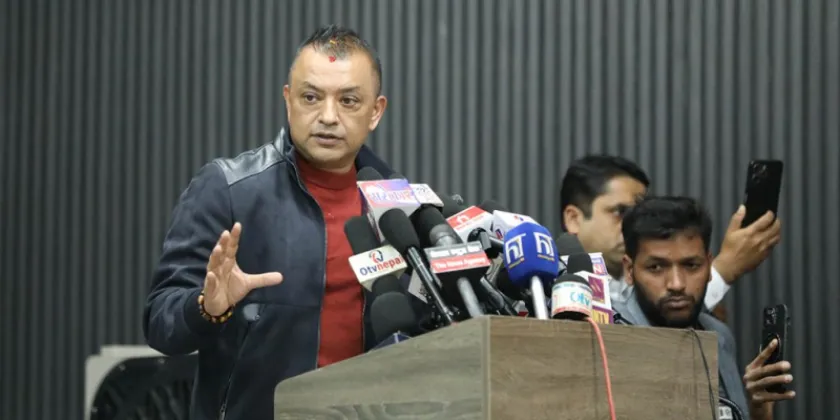
Kathmandu - Nepali Congress leader Gagan Thapa on Sunday warned that a small group within the government has begun to act as if it were the state itself, treating its own words as commands that must be obeyed rather than statements open to question. He said the arbitrary use of state power and the belief that one's own will is law has crossed all limits, and he pressed for such tendencies to be confronted rather than quietly accepted. The remarks, reported by NepalPress, amount to a pointed critique of the way power is currently being exercised at the top of the government.
'We Are the State': The Mindset Thapa Says Has Taken Hold
At the heart of Thapa's warning lies a distinction he argued the government has lost sight of: the government is not the state. A government is a temporary custodian of state institutions, holding office for a defined period and answerable to the public and the constitution. The state, by contrast, belongs to all citizens and endures beyond any single administration. According to the Congress leader, a small group in power has begun to blur this line, behaving as though the authority of the state flows from them personally rather than from the people they serve.
Thapa said the government should not harbour the illusion that "we are the state" and "my will is the law." In his telling, this is not merely loose rhetoric but a working assumption that shapes how decisions are made and how dissent is received. When those in power come to see themselves as the state personified, he suggested, official pronouncements stop being positions to be debated and become orders to be complied with.
The distinction matters because it changes the terms of political life. Under a proper constitutional arrangement, criticism of the government is a normal and protected activity, precisely because the government and the nation are not the same thing. If the two are treated as one, disagreement with those in office becomes disagreement with the country itself, and the space for legitimate opposition narrows accordingly.
Words as Commands, Not Statements
Thapa reserved his strongest language for what he described as the arbitrary use of state power. In a democratic system, statements from the government are meant to invite scrutiny: they can be questioned in Parliament, challenged in the courts, debated in the press and, ultimately, judged by the public. Commands function differently. They presume obedience and leave little room for questioning. When commands are issued in the name of the state by a small circle, the channels of accountability quickly narrow.
His concern, as he framed it, is that this pattern has already intensified beyond acceptable bounds. The belief that one's own will is law, he said, has crossed all limits. His warning pointed to several interlocking dangers:
- the conflation of a small ruling group with the state itself, so that opposing the government comes to be treated as opposing the nation;
- official statements delivered as commands, expecting compliance rather than debate;
- the arbitrary exercise of state power, in which decisions rest on personal will rather than established process;
- the growing conviction among those in office that their will is, in effect, the law.
Taken together, these tendencies describe a style of rule in which process is secondary to power. Thapa's point was that the problem is not confined to any single decision or announcement, but lies in the underlying attitude that produces such decisions, an attitude in which the convenience of the ruler outweighs the discipline of the rulebook.
'Must Not Be Normalised'
Perhaps the most significant element of Thapa's intervention was his insistence that such tendencies must not be normalised. His argument was not simply that something improper had occurred, but that a style of governing is being settled into place, one that could outlast the current government if it goes unchallenged. Habits formed by one administration, the warning implied, can harden into expectations for those who follow, making each departure from proper conduct easier to justify than the last.
The stakes he identified are familiar ones in any debate over democratic governance. The rule of law requires that power be exercised through known and consistent procedures, and that no one, including those in the highest offices, stand above the law. Accountability requires that decisions affecting the public be explainable to institutions with the authority to question them. Where a ruling group treats its word as law, both principles come under strain: laws become expressions of will, and oversight becomes an inconvenience to be bypassed rather than a duty to be honoured.
Thapa's remarks were published by NepalPress on Sunday. His message was unambiguous: a government that mistakes itself for the state mistakes temporary power for permanent authority, and a public that accepts the one may find it difficult to reclaim the other. What he made clear is that, in his view, the time to push back is now, before the extraordinary becomes the everyday.