
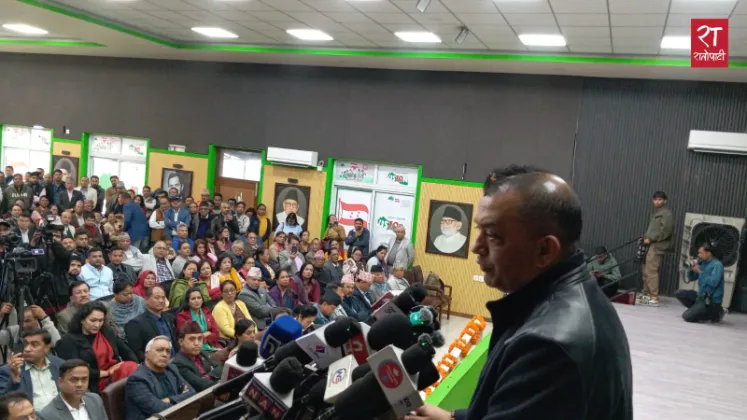
Nepali Congress President Gagan Thapa said on Sunday that the current government’s arbitrariness in Nepal had crossed all limits, accusing its coalition partners of remaining silent over what he described as the government’s wrongdoings. In a statement, Thapa also questioned the Rastriya Swatantra Party’s (RSP) conduct and argued that political statements alone were not enough, calling instead for results.
Thapa criticizes government conduct
Thapa’s central charge was that the government had gone beyond acceptable limits in its exercise of authority. His statement framed the issue as more than a disagreement over individual decisions: it raised a broader question about how the government is behaving and whether those in power are being held to account. The statement did not, in the information available, identify specific actions or decisions behind the accusation, so the criticism was presented as a general assessment of the government’s conduct.
The Nepali Congress president also directed criticism at the parties supporting the government. He said coalition partners had remained silent over the government’s wrongdoings, placing responsibility not only on the government itself but also on those aligned with it. His remarks suggest that, in his view, participation in a governing coalition carries an obligation to respond when the government is accused of acting improperly. Silence, in this framing, is itself a political choice that leaves the government’s conduct unchallenged.
Thapa’s statement therefore put two related concerns at the centre of the debate: the government’s alleged arbitrariness and the response of parties that are part of the coalition. He called attention to the relationship between governing authority and political accountability, arguing that the conduct of coalition partners matters alongside the actions of the government. He did not simply ask those parties to comment; he criticized their failure to speak out over the alleged wrongdoings.
Questions over the RSP’s position
A particular focus of Thapa’s criticism was the Rastriya Swatantra Party. He questioned what he described as the party’s double standards, challenging the consistency between its positions and its conduct. The statement did not provide further detail about the specific positions or actions behind that charge. Thapa’s criticism was nevertheless pointed: he singled out the RSP rather than limiting his remarks to a general appeal to coalition partners.
The allegation of double standards puts consistency at the heart of the political dispute. Thapa’s remarks imply that a party’s public statements should be measured against how it acts when faced with the government’s conduct. In his account, the RSP’s position warranted scrutiny, while the wider coalition’s silence raised questions about whether its members were prepared to challenge the government. The statement did not set out a detailed comparison, but it clearly called on the party to answer for what Thapa sees as a gap between its standards and its behavior.
A call for results, not statements
Thapa stressed that statements alone were insufficient and that results were needed. The appeal shifts the emphasis from political messaging to practical outcomes: declarations of concern, by themselves, do not answer the criticism he raised about the government or the coalition’s response. His demand for results was presented as a standard by which political actors should be judged, rather than as a call for more public comment.
The distinction matters to the substance of his message. Thapa criticized the government’s conduct, challenged coalition partners for remaining silent and questioned the RSP’s consistency, but he also warned against treating statements as a substitute for action. His remarks call on political parties to demonstrate their positions through results. The statement did not specify which outcomes he expected or set out a particular course of action, so the demand remained broad.
Taken together, Thapa’s Sunday statement was a challenge to both the government and the parties supporting it. He said the government’s arbitrariness had crossed the limits, accused coalition partners of failing to speak up over alleged wrongdoings and questioned the RSP’s double standards. His concluding emphasis was that political responses should be judged by what they deliver, not simply by what parties say.


