
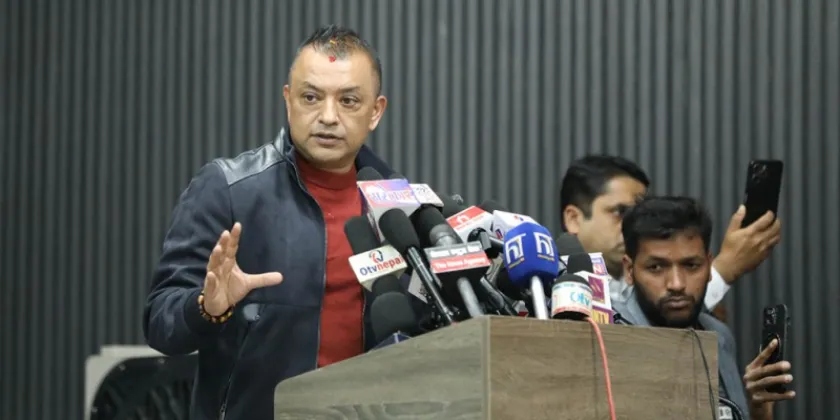
KATHMANDU - The secretariat of Nepali Congress President Gagan Thapa on Monday rejected the news reports and allegations circulating in sections of the media and on social media concerning the party's official legitimacy, insisting that the main opposition party's standing has already been confirmed by the Election Commission, the courts and the 15th general convention. In a strongly worded statement, the secretariat went a step further, accusing the government of deliberately spreading confusion and allegations against the opposition Nepali Congress to divert public attention from its own recent activities, and questioning the impartiality and transparency of the investigation process connected to the claims.
'Deliberate disinformation', says the secretariat
The statement, reported by Nepal Press, presents the controversy over the Congress's official status not as a genuine organisational dispute but as a manufactured campaign. According to the secretariat, the party's legitimacy is not an open question, and it cited three separate confirmations to make the case:
- The Election Commission, the constitutional body that registers and recognises political parties, which the secretariat said has already confirmed the party's legitimacy.
- The courts, whose pronouncements the secretariat said have settled the questions raised about the party's official position.
- The 15th general convention, the party's supreme organisational gathering, which the secretariat cited as a further affirmation of its legitimacy.
By listing these three authorities together, the secretariat sought to close off any argument that the party's official status remains unresolved. Its language was unambiguous: the reports and social media allegations, it said, amount to deliberate disinformation rather than legitimate scrutiny, and the secretariat positioned itself as correcting the record rather than responding to a real internal challenge.
Objection to the 'middlemen' connection
A distinctive feature of Monday's statement is its specific objection to attempts to link the dispute over the Congress's official status to middlemen. Rather than addressing only the broad question of legitimacy, the secretariat pushed back against the framing that has connected the party's organisational question to middlemen, rejecting that association outright. The intervention suggests the linkage had gained enough traction in media and social media discussion to warrant a formal denial from the party president's secretariat.
The secretariat also turned its fire on the process behind the allegations, questioning the impartiality and transparency of the investigation tied to them. That shift is significant: the objection is no longer confined to the substance of the reports but extends to whether the process generating them can be trusted at all. By challenging both impartiality and transparency, the Thapa secretariat has signalled that it views the investigation itself, and not merely the coverage surrounding it, as part of the problem.
Accusations against the government
The sharpest political charge in the statement is directed at the government. The secretariat accused the government of deliberately spreading confusion and allegations against the opposition Nepali Congress, and argued that the purpose is to divert public attention from the government's recent activities. In other words, the secretariat does not treat the controversy as an accident of poor reporting but as a strategy, with the ruling side cast as both its author and its beneficiary.
That framing sharply escalates tensions between the main opposition and the government. By characterising the allegations as deliberate, the secretariat has effectively accused the government of using disinformation as a political tool against the party at a moment when public attention might otherwise rest on the government's own conduct. The restatement of the record, with the Election Commission, the courts and the 15th general convention cited as having already spoken, was presented as the corrective intended to deny the allegations any foothold.
Why official status matters
In Nepal's political system, questions over a party's official status are far from symbolic. Recognition by the Election Commission underpins a party's ability to operate as a registered political entity, including the use of its electoral symbol and its participation in official electoral processes. Court rulings, meanwhile, can determine which leadership decisions carry legal weight. It is precisely because the stakes are so high that disputes of this kind draw intense scrutiny, and why the secretariat moved quickly on Monday to rebut any suggestion that the Congress's official standing is in doubt.
For Gagan Thapa's secretariat, the statement marks a clear attempt to seize control of the narrative: to declare the legitimacy question closed, to reject the attempts to link the dispute to middlemen, and to reframe the story as one of government diversion. Whether the statement quiets the reports and social media claims it rejects remains to be seen, but the party has made clear it intends to fight the allegations on the grounds of record rather than rumour, pointing to the Election Commission, the courts and the 15th general convention as the authorities that have already settled the matter.


