
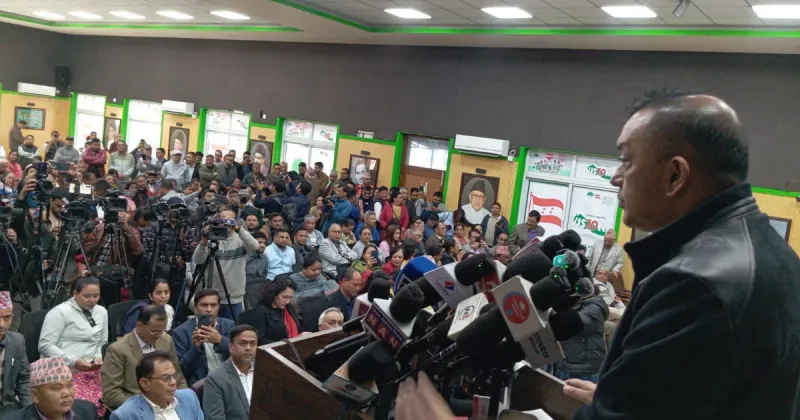
Nepali Congress General Secretary Gagan Thapa questioned the Rastriya Swatantra Party (RSP) over how it shares credit and responsibility for the government’s work, asking whether the party would answer for wrongdoings or leave accountability to the prime minister alone. His remarks were reported in Nepal on November 1, 2026, including by Nagarik News, Setopati and OnlineKhabar.
Thapa challenges RSP’s approach
Thapa’s question focused on what he described as an imbalance: taking credit for the government’s positive work while placing responsibility for its mistakes on the prime minister alone. Speaking as the Nepali Congress general secretary, he challenged the RSP to clarify whether it would also accept responsibility when concerns were raised about the government’s actions.
The remarks put the issue of political accountability at the centre of his criticism. Thapa’s question was not simply about who should be associated with achievements, but also about whether the party would stand behind the government when its conduct came under scrutiny. He asked whether responsibility would be shared or whether it would rest solely with the prime minister.
The available reports do not identify a particular government decision or wrongdoing as the subject of Thapa’s remarks. His criticism, as reported, concerned the broader question of how the RSP responds to both the government’s successes and its mistakes. He called on the party to address whether it would take responsibility when questions arose.
Credit and accountability
Thapa’s challenge draws a distinction between claiming recognition for good work and accepting consequences when that work is questioned. In his framing, a party that associates itself with government achievements should also explain what role it accepts when errors or alleged wrongdoings become an issue. His remarks asked the RSP to make clear where it stands on that responsibility.
The question also highlights the difference between the prime minister’s individual accountability and the responsibility of a political party. Thapa asked whether the RSP would leave the prime minister to answer alone or whether the party would take responsibility as well. The reports provided no response from the RSP to his question, and did not detail any specific action by the government that prompted it.
Thapa’s remarks therefore centred on a direct challenge to the RSP: whether it would claim a share of credit for the government’s good work while also accepting a share of responsibility when its conduct faced criticism. The question, reported by multiple Nepali outlets, put the party’s position on accountability under scrutiny without identifying a particular government decision or setting out a response from the party.


