
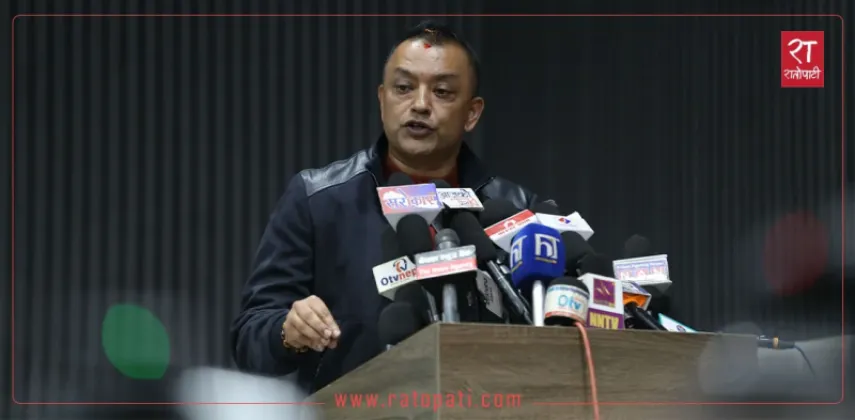
Nepali Congress President Gagan Thapa on Sunday objected to police taking the Director General of the Irrigation Department and the head of the Sunkoshi Marin Diversion to the Prime Minister’s Office and making them give statements there. Speaking at a press conference at the party’s central office in Sanepa, Thapa said that if employees had committed wrongdoing, the matter should be investigated through legal procedures and established institutions.
Thapa calls for legal procedures
Thapa challenged the use of the Prime Minister’s Office as the place where the two officials were taken for questioning. His objection, as presented at the press conference, was that alleged misconduct by public employees should be addressed through the appropriate legal process rather than by taking them to the PM’s Office and holding them there.
He said an employee suspected of making a mistake should not simply be summoned to the Prime Minister’s Office and detained. Instead, the allegations should be dealt with legally. The distinction he drew was between investigating possible wrongdoing and the manner and location in which officials are questioned.
The two officials identified in the account were the Director General of the Irrigation Department and the head of the Sunkoshi Marin Diversion. Thapa said police had forcibly taken them to the PM’s Office and made them provide statements. The account did not provide further details about the allegations concerning the officials or the subject of their statements.
Reference to an earlier passport case
Thapa also pointed to an earlier case involving the printing of passports. He said an Anti-Corruption Commission commissioner and an employee of the Foreign Ministry had previously been confined at the Prime Minister’s Office in connection with that case.
By raising the passport-printing case alongside the latest incident, Thapa placed his criticism in the context of more than one instance in which officials were taken to or held at the PM’s Office. His remarks focused on the proper channel for dealing with public employees when questions arise about their conduct.
The reference does not, on its own, provide further details about the earlier case or the circumstances in which the commissioner and ministry employee were confined. Thapa’s stated position was that such matters should be handled through legal procedures and established institutions, rather than through detention at the Prime Minister’s Office.
Emphasis on institutional process
Thapa’s comments addressed the treatment of government employees accused or suspected of wrongdoing, while also emphasizing the role of institutions and legal procedure in investigating allegations. He did not argue that employees should be exempt from investigation; rather, he said that allegations should be examined through the established legal process.
The press conference was held at the Nepali Congress central office in Sanepa on Sunday. The account of Thapa’s remarks did not include a response from the police or the Prime Minister’s Office, nor did it provide details about any formal proceedings concerning the two officials.
His criticism therefore centered on how and where the officials were questioned, and on the need for allegations against employees to be dealt with through lawful channels. Thapa’s reference to the earlier passport-printing case underscored his concern about officials being confined at the PM’s Office while matters involving them are being addressed.


