
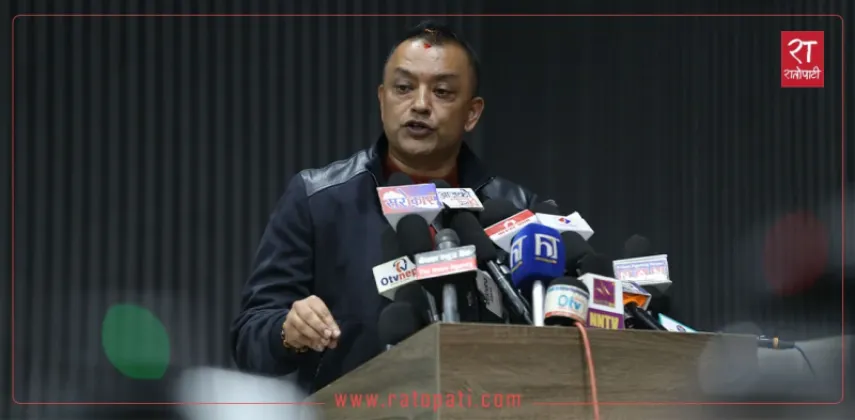
Kathmandu: Nepali Congress President Gagan Kumar Thapa on Sunday demanded that the government conduct an impartial and in-depth investigation into all of the brokerage-related scandals that have recently surfaced, and openly questioned whether the administration's intentions behind the ongoing probes are genuine. Addressing a press conference organised at the party's central office in Sanepa, Thapa criticised the government's investigation process, saying it appeared to focus on only selected issues and individuals rather than pursuing every case that has come to light.
A Demand for an Impartial and In-Depth Investigation
Thapa used Sunday's press conference to press the government to broaden and deepen its response to the brokerage-related scandals, insisting that every case that has recently emerged be examined fully and without bias. According to a report by RatoPati, the Nepali Congress leader made the demand while speaking to journalists at the party's central office in Sanepa.
The demand, as he framed it, rests on two pillars. The first is impartiality: the investigation must be conducted free of political considerations and must not be steered toward predetermined conclusions. The second is depth: the probes must go beyond surface-level scrutiny and get to the bottom of each scandal, however inconvenient the findings may prove for those in power.
By calling for the government to investigate all of the recently surfaced scandals, Thapa effectively set a benchmark against which the administration's conduct can now be measured. In his telling, anything short of a comprehensive and even-handed probe would fail the basic test of accountability.
"Selected Issues and Individuals": Concerns Over Selective Targeting
Central to Thapa's criticism was his charge that the government's investigation process appears selective. Rather than pursuing all of the cases that have surfaced, he said, the process seemed to single out particular issues and particular individuals, a pattern that raises questions about how investigators decide what to pursue and whom to scrutinise.
The implication of that criticism is significant. If probes are perceived as being aimed at chosen targets, Thapa suggested, the entire exercise risks losing credibility before any findings are even announced. An investigation process that treats similar matters differently, depending on the issues or the individuals involved, sits uneasily with the principle that the rules should apply equally to everyone.
His remarks also carry a procedural message. By questioning how the government selects what gets investigated, Thapa is effectively demanding transparency at the very first stage of the process, before evidence is gathered and conclusions are drawn. In his view, the fairness of an investigation is judged not only by its outcome but by the even-handedness with which its scope is defined in the first place.
Doubts Over the Government's Intentions
Beyond the mechanics of the probes, Thapa raised a more fundamental question: whether the government's intentions behind the investigations are genuine at all. In doing so, he signalled a deep scepticism about whether the process, as currently pursued, is truly designed to uncover the whole truth behind the scandals.
That doubt is closely tied to his concern about selectivity. In his assessment, a government that pursues only selected issues and selected individuals while leaving other cases unexamined invites the perception that the investigations serve a narrower purpose than the public one they claim to serve. Restoring confidence, in his view, would require the government to demonstrate, through its actions, that the probes are genuinely impartial and comprehensive.
For now, the burden of proof, as Thapa framed it, lies squarely with the government. His comments at the Sanepa press conference make clear that he intends to keep pressing the issue, insisting that all of the recently surfaced brokerage-related scandals deserve nothing less than a thorough and unbiased investigation.
At a Glance: Thapa's Key Points
- The government must investigate all of the brokerage-related scandals that have recently surfaced, not only a selection of them.
- The current investigation process appears to target selected issues and individuals rather than every case.
- Doubts persist over whether the government's intentions behind the investigations are genuine.
- The probes must be impartial and in-depth if they are to withstand scrutiny.
What Comes Next
The remarks place fresh political pressure on the government at a time when the recently surfaced brokerage-related scandals remain in the public eye, as reported by RatoPati. Whether the administration responds by widening the scope of its investigations, as Thapa has demanded, will be closely watched in the days ahead. Until then, the Nepali Congress leader's challenge stands: investigate everything, investigate thoroughly, and convince the public that the intention behind the probes is genuine.


