
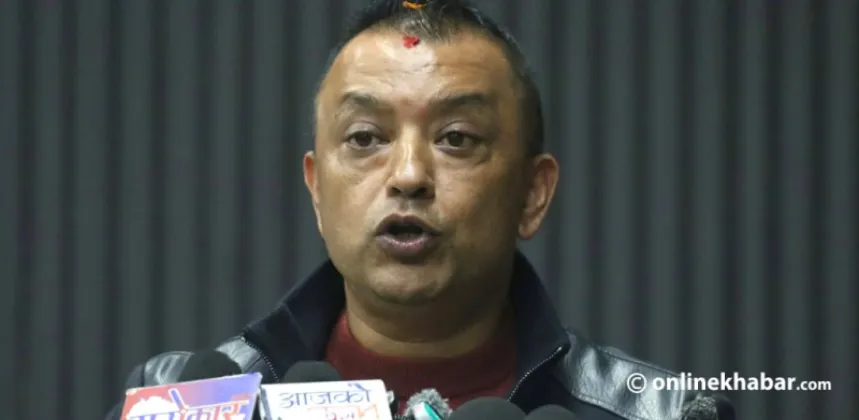
KATHMANDU - Nepali Congress President Gagan Thapa on Sunday accused the government of steering the country toward arbitrary and autocratic rule, saying a small group within the state machinery had begun behaving as though it were the state itself and that its wishes amounted to law. Addressing a press conference organised at the party office in Sanepa, Thapa said the government's recent conduct on constitutional matters, press freedom and freedom of expression had given rise to serious concerns, and he separately demanded accountability from the Rastriya Swatantra Party (RSP).
The remarks, reported by Onlinekhabar and Khabarhub, amount to a direct challenge to the way state power is currently being exercised, and they place Thapa among the most pointed critics of the government's style of functioning.
"A small group behaving as the state"
At the heart of Thapa's address was a warning about who controls the machinery of the state and how. He said a small group within that machinery had begun acting as if it alone embodied the state, treating its own preferences as though they carried the force of law. In his view, this marks a shift away from governance under established rules and toward governance by discretion, where outcomes depend on the wishes of a few rather than on constitutional process and institutional accountability.
Thapa characterised the government's trajectory as arbitrary and autocratic, framing his critique not as routine opposition rhetoric but as a warning about the direction in which the state is moving. According to his assessment, the problem is not confined to any single decision. Rather, it lies in a pattern of behaviour in which the boundaries that are supposed to constrain those in power are increasingly treated as optional.
His core allegations can be summarised as follows:
- The government is drifting toward arbitrary and autocratic rule.
- A small group within the state machinery behaves as though it were the state itself.
- The wishes of that group are being treated as though they amounted to law.
- Recent conduct on constitutional matters, press freedom and freedom of expression has raised serious concern.
By choosing a press conference at the party's Sanepa office to lay out these charges, Thapa signalled that he intends to keep the question of governmental conduct at the centre of political debate.
Press freedom and the constitution in focus
Thapa devoted particular attention to the treatment of the press and to constitutional norms. He cited incidents in which police were deployed into a media house to arrest journalists, describing the government's recent conduct on press freedom and freedom of expression as alarming. The deployment of security personnel into a newsroom to detain journalists is, in any democratic setting, a grave matter: it touches directly on the ability of the media to report without intimidation and on the public's right to information.
In his telling, concern over press freedom cannot be separated from concern over the constitution, because both rest on the same foundation - the principle that power is limited by rules binding on the government as much as on anyone else. When police action reaches into a media house, and when constitutional questions are handled in a manner that alarms the opposition, the cumulative effect, he argued, is a state that increasingly accommodates dissent only on its own terms.
Thapa's warning on these points carried a clear implication: if the government's conduct toward the press and the constitution is left unchallenged, the space for free expression and independent journalism will continue to narrow. His remarks were framed as a call for vigilance, positioning the protection of press freedom and free expression as a shared democratic responsibility rather than the concern of the media alone.
Accountability demand aimed at the RSP
Thapa did not confine his criticism to the government. He also demanded accountability from the Rastriya Swatantra Party, extending his scrutiny beyond the ruling side to a party that has positioned itself as an alternative to the established political class. The reported remarks do not detail the specific questions he wants the RSP to answer, but the demand itself indicates that Thapa is pressing for accountability across the political spectrum rather than from the government alone.
By pairing his warnings about autocratic drift with a call for the RSP to be answerable, Thapa sought to present accountability as a principle rather than a partisan weapon. That framing is significant: it suggests his critique of the government is part of a broader argument about how power, wherever it sits, should be exercised, scrutinised and checked.
A warning about the direction of the state
Taken together, the points Thapa raised at Sanepa sketch a consistent argument. His concern is not one controversial act but a pattern: a government whose conduct, he said, raises questions about the constitution, about press freedom and about freedom of expression, and a state machinery in which a small group increasingly behaves as the ultimate authority.
His remarks add to the pressure on both the government and the RSP to respond to the questions he has raised in public. For now, the Sanepa press conference stands as a pointed statement of concern from a senior Congress leader: that the instruments of the state are being used in ways that threaten constitutional rule, press freedom and free expression, and that those who hold power, as well as those who aspire to it, must be held to account.


