
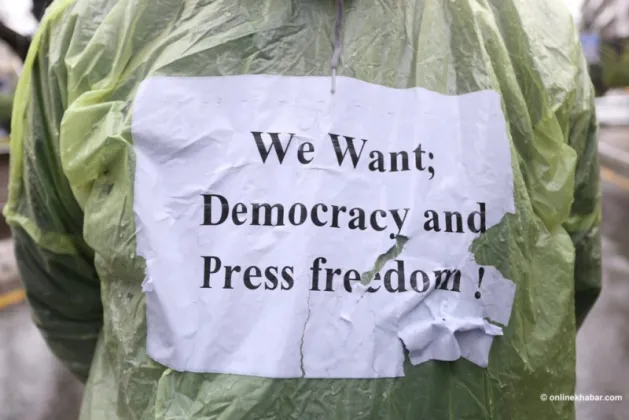
Dozens of journalists gathered at Maitighar in central Kathmandu, standing through persistent rain to demand an immediate end to what they describe as a mounting crackdown on Nepal's press. The demonstration was called by the Federation of Nepali Journalists (FNJ) and was organised in response to a rise in the arrest of journalists, raids on media houses, and interference by government and police authorities inside newsrooms. Carrying banners and chanting slogans against government overreach, the protesters issued a clear demand: authorities must halt actions they say are steadily eroding press freedom in the country.
Protesters Brave the Rain in Kathmandu
The gathering at Maitighar, one of the capital's most frequently used sites for public demonstrations, brought together journalists from across the profession under the FNJ banner. Despite the rain falling steadily throughout the event, participants remained in place, holding up banners and raising slogans directed at the government. The demonstration was peaceful in character, built around a unified message of resistance to what protesters see as escalating pressure on the media.
According to a report by OnlineKhabar, the protest was convened specifically to push back against a series of actions targeting journalists and media institutions. The choice of Maitighar placed the demonstration in the middle of the capital's main artery, ensuring the journalists' demands were visible to commuters and officials alike.
The persistence of the crowd through the downpour underscored the seriousness with which organisers view the current situation. For a profession that regularly covers the demonstrations of others, the sight of dozens of journalists themselves rallying in the rain marked a pointed show of collective concern.
Arrests, Raids and Interference in Newsrooms
Organisers framed the protest around three core grievances, each of which they say points to a broader pattern of press suppression:
-
Rising arrests of journalists - demonstrators objected to an increase in the detention of reporters, arguing that journalists are being targeted for their work rather than treated as professionals carrying out a public function.
-
Raids on media houses - the protest also responded to police action against media organisations, which protesters described as an attempt to intimidate newsrooms and disrupt their ability to publish.
-
Interference inside newsrooms - participants condemned the entry of government and police authorities into editorial spaces, warning that such intrusions threaten the independence that allows media outlets to report without fear or favour.
Taken together, the three grievances formed the backbone of the protest's slogans and banners, which repeatedly criticised government overreach. The demonstrators presented the measures not as isolated incidents but as part of a coordinated pattern that, if left unchallenged, would normalise state pressure on the press.
What the Protesters Are Demanding
The central demand voiced at Maitighar was an end to the crackdown on the press. For the journalists present, that means stopping the arrests of their colleagues, ceasing raids on media premises, and ensuring that government and police authorities stay out of newsrooms. The FNJ, as the country's principal organisation of working journalists, positioned itself as the voice of a profession that feels increasingly under siege.
The protest also carried a broader message about the role of the media in a democratic society. Speakers and slogans emphasised that a press free from arrest, raids and interference is a precondition for holding power to account. By gathering in the heart of the capital, the demonstrators sought to remind both the government and the wider public that attacks on journalists are attacks on the public's right to information.
A Test for Press Freedom in Nepal
The demonstration at Maitighar adds to the growing tension between Nepal's media community and the authorities. The FNJ's decision to call journalists onto the streets reflects the depth of concern within the profession over the reported rise in arrests, raids and newsroom interference.
For the government, the protest represents a public challenge to justify its handling of the press. For journalists, it is an early step in a campaign to reverse what they describe as a worsening environment for media work. Whether the authorities respond by easing the pressure or by continuing the practices denounced at Maitighar will likely shape the next phase of the confrontation between the press and the state.
As the rain fell over the protest site, the message from the crowd remained unchanged. The journalists who gathered at Maitighar made clear that they intend to keep demanding an end to the crackdown, and that they regard the defence of press freedom as a fight they cannot afford to lose.


