
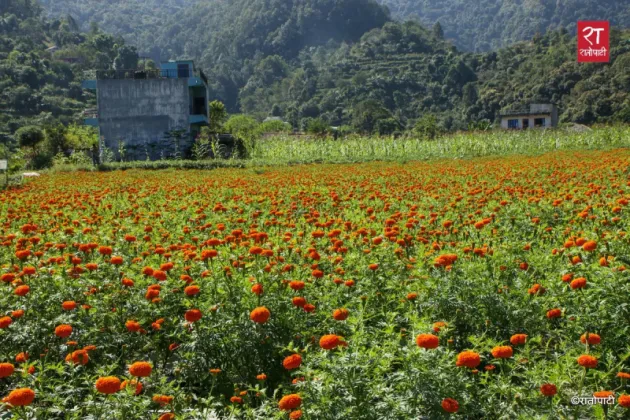
Farmers in Banke district are turning to commercial flower farming in growing numbers after Nepal imposed a ban on the import of flowers from India, a restriction that has pushed the domestic market to rely more heavily on flowers grown at home. According to Bindu Chartimagar, a central member of the Floriculture Association Nepal and a flower entrepreneur from Nepalgunj, farmers in Nepalgunj, Kohalpur, Khajura and Janaki Rural Municipality have taken up commercial flower cultivation this year. The shift, reported by RatoPati, Nagarik News and Khabarhub, is being read locally as evidence that restrictions on imported flowers can open real space for Nepali growers.
Import Ban Alters the Flower Market
The ban on Indian flower imports has changed the supply picture for Nepal's flower trade, which can no longer depend on flowers arriving from across the southern border. With those imports halted, demand is being directed toward domestically grown flowers, and Chartimagar says farmers in Banke have responded by moving into commercial cultivation. For a sector seeking to establish itself against foreign competition, the restriction has effectively handed domestic growers a larger share of the market to serve.
The response in Banke is notable for how quickly it has materialized. Farmers across several local units of the district have adopted flower cultivation within the same year, indicating that the opportunity created by the import ban is being recognized widely rather than by a few isolated growers. According to Chartimagar, the increase in interest is a direct outcome of the changed market conditions that followed the import restriction, and it marks a visible expansion of commercial floriculture in the district.
New Growers Across the District
The localities identified as centers of the new activity are:
- Nepalgunj, the district's sub-metropolitan city and home to Chartimagar's own flower enterprise
- Kohalpur
- Khajura
- Janaki Rural Municipality
That these areas span different parts of Banke suggests commercial floriculture is taking root beyond a single pocket of the district. Farmers in the urban center of Nepalgunj and in the surrounding local units alike have begun cultivating flowers for commercial sale, a pattern that aligns with the broader push to replace imported flowers with domestic production. For farmers looking for new sources of income, the current market environment has made flower farming a considerably more attractive proposition than it was before the ban.
The breadth of the adoption also matters for the sector's future. When new growers emerge simultaneously in a sub-metropolitan city, in municipality areas and in a rural municipality, the resulting network of producers is spread across the district rather than concentrated in one market town. That distribution can support a more resilient local flower trade as the new farmers establish their operations.
A Decade in the Flower Business
The assessment of rising interest comes from a grower with long experience in the field. Chartimagar, a resident of Nepalgunj Sub-Metropolitan City-20, has been engaged in commercial flower farming for about a decade, a span that has allowed her to watch the sector in and around Nepalgunj mature from early experimentation into a more established line of business. Alongside her work as an entrepreneur, she represents the sector nationally as a central member of the Floriculture Association Nepal.
Her position gives particular weight to her observation that the import ban has drawn new farmers into flower cultivation. A decade of continuous operation also demonstrates that commercial flower farming can be sustained in the Banke region over the long term, an example that carries significance for the newcomers now entering the trade. As more farmers follow the path she has taken, the district's floriculture sector gains new producers with each season, strengthening the base from which the local industry can grow.
A Sector Gains Momentum
For Banke, the influx of new flower farmers represents a meaningful shift in the district's agricultural activity. Commercial floriculture is expanding into local units where it had not previously taken hold, and the timing, driven by the ban on Indian flower imports, has given domestic growers an opening to supply a market that can no longer be met from abroad. The fact that farmers in Nepalgunj, Kohalpur, Khajura and Janaki Rural Municipality all began commercial cultivation this year points to a broad-based rise in interest rather than isolated experimentation.
The Floriculture Association Nepal, through office bearers such as Chartimagar, remains central to this expansion, linking growers in districts like Banke to the wider network of Nepal's flower trade. Whether the momentum built during the import ban can be sustained will depend on how the new entrants fare in the seasons ahead. For now, however, the direction of travel in Banke's floriculture sector is clear: with imported flowers shut out of the market, local farmers are claiming the ground they have left behind.


