
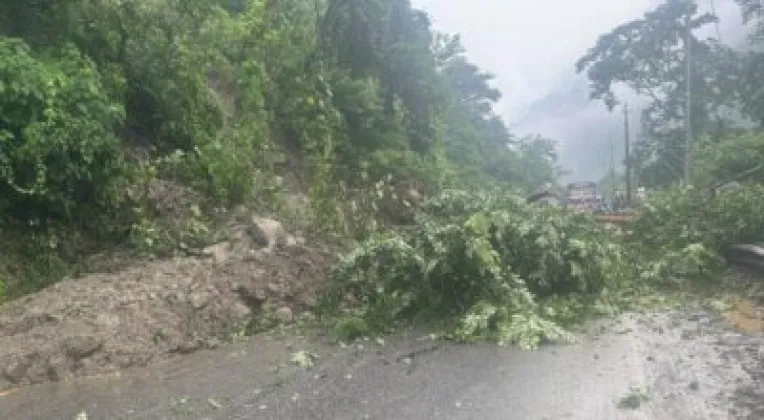
Continuous rainfall has left more than a dozen road sections across Nepal blocked by floods and landslides, disrupting travel on key highways and rural routes alike, according to the Police Headquarters. The affected routes include the Prithvi Highway, one of the country's busiest arterial roads, along with multiple road sections in Gorkha, Kavrepalanchok and Surkhet districts. In a separate restriction, vehicle movement on the Kanti Lokpath, which connects Makawanpur and Lalitpur, has been suspended at night owing to the danger of further landslides on the route. The widespread blockages show how a sustained spell of rain can quickly sever districts from the national road network, forcing travelers and transport operators to alter plans at short notice.
Blocked routes spread across the country
Police Headquarters has said that the continuous rain has obstructed more than 12 road sections nationwide. The damage is not confined to a single region: blockages have been reported on highway sections as well as on district and rural roads, indicating that both long-distance and local travel have been hit by the ongoing wet weather.
The principal locations named in the police assessment are:
- The Prithvi Highway, a central artery for traffic between the Kathmandu Valley and Pokhara, is among the roads blocked by flood and landslide debris.
- Road sections in Gorkha, Kavrepalanchok and Surkhet districts have been obstructed, cutting off movement in parts of the hilly terrain.
- The Kanti Lokpath, which links Makawanpur with Lalitpur, remains open only during the day, with vehicles barred at night because of landslide risk.
- In Gorkha, road connectivity between Arughat Rural Municipality-2 and another ward of the rural municipality has been disrupted, leaving local residents facing difficulties in movement.
The list underlines that the disruption spans from major highways that carry the bulk of passenger and freight traffic to small rural roads on which entire communities depend for access to markets, schools and health facilities. With more than a dozen sections affected at once, clearance work and traffic management are likely to remain a challenge until the rain eases.
Night restrictions on Kanti Lokpath
One of the most significant measures announced alongside the blockage report concerns the Kanti Lokpath, the road that connects Makawanpur and Lalitpur districts. Authorities have suspended the movement of vehicles on this route at night, citing the risk that further landslides could be triggered by the continuing rainfall.
The restriction means traffic on the road is effectively limited to daylight hours. For drivers, the suspension adds a second layer of difficulty: even where the road surface is passable, travel after dark is not permitted until conditions improve. Motorists who normally use the route for evening or early-morning journeys between Makawanpur and Lalitpur will need to reschedule their trips or look for alternative routes.
A precautionary measure
The night-time ban on the Kanti Lokpath is precautionary in nature, designed to prevent vehicles from being caught on the road if a fresh landslide comes down in the dark. Blocking night movement reduces the chance of vehicles being trapped under debris or stranded on a damaged stretch with no visibility and no immediate help at hand. Such restrictions are a familiar feature of the rainy season on Nepal's hill roads, where a single slope failure can close a route for hours or even days.
Arughat's severed link
The disruption is not limited to highways used by long-distance travelers. In Gorkha district, road connectivity between Arughat Rural Municipality-2 and another ward has been cut, according to the information shared by police. For a rural municipality in the hills, the loss of a road link between wards can isolate settlements and complicate the movement of people and essential supplies until the route is restored.
Gorkha is among the districts where rainfall has obstructed multiple road sections, and the disruption around Arughat illustrates how floods and landslides reach far beyond the national highway network. Rural roads, often built along steep slopes and narrow ridges, are frequently the first to be blocked when heavy rain loosens soil and rock on the hillsides above them.
Rain continues to test the road network
The Police Headquarters' account of more than 12 blocked road sections provides a snapshot of a transport network under sustained pressure from the weather. With rain continuing in many parts of the country, the number of affected routes could change as fresh information arrives from the districts.
Nepal's hilly topography and its web of roads carved into fragile slopes make the country's road system particularly vulnerable during extended periods of rain. Flooded rivers can wash away culverts and road shoulders in the valleys and lowlands, while saturated hillsides in the middle hills and mountains regularly give way as landslides. The current blockages, spread across districts as far apart as Gorkha in Gandaki Province, Kavrepalanchok in Bagmati Province and Surkhet in Karnali Province, reflect that dual threat of flood and landslide damage.
For now, travelers planning to use the affected routes, including the Prithvi Highway and the Kanti Lokpath, face the prospect of delays, detours and, in the case of the Kanti Lokpath, an outright night-time ban. Updates on when the blocked sections will reopen are expected to follow as police and local authorities assess conditions on the ground once the weather allows.


